

If you blinked, you might’ve missed it. CLAWDBOT (also seen as Claudebot, Clawbot, even “Clawed with Hands”) went from “this is the future” to “what just happened?” in about three days.
On the surface, it looked like the perfect open-source AI assistant: memory across chats, tons of integrations, and the power to actually do tasks, not just talk about them. Then came the messy part, a rushed naming scramble, hijacked identities, handle squatting, fake profiles, exposed API keys, and a crypto token that reportedly ran up to around a $16 million market cap before collapsing hard. Real people lost real money in the confusion.
This story matters even if you never touched CLAWDBOT. Because the next viral AI agent will show up soon, and it’ll promise even more. The goal here is simple: understand what happened, and walk away with a few habits that keep you from being the next easy target.
What CLAWDBOT promised, and why people fell for it so fast
CLAWDBOT didn’t go viral because it was funny. It went viral because it sounded useful in that dangerous way, like “why doesn’t this exist already?” It wasn’t pitched as a chatbot you chat with, it was pitched as an assistant that can take actions across your life. It could sit inside messaging apps, connect to services, and remember what you told it yesterday, last week, last month. That’s the dream a lot of us have had since the first “smart assistants” started setting 5-minute timers and calling it productivity.
And the social proof hit fast. Developers watched the GitHub stars explode (thousands in the first day, then tens of thousands soon after). That kind of momentum creates a weird pressure. You feel late even when the project is 12 hours old.
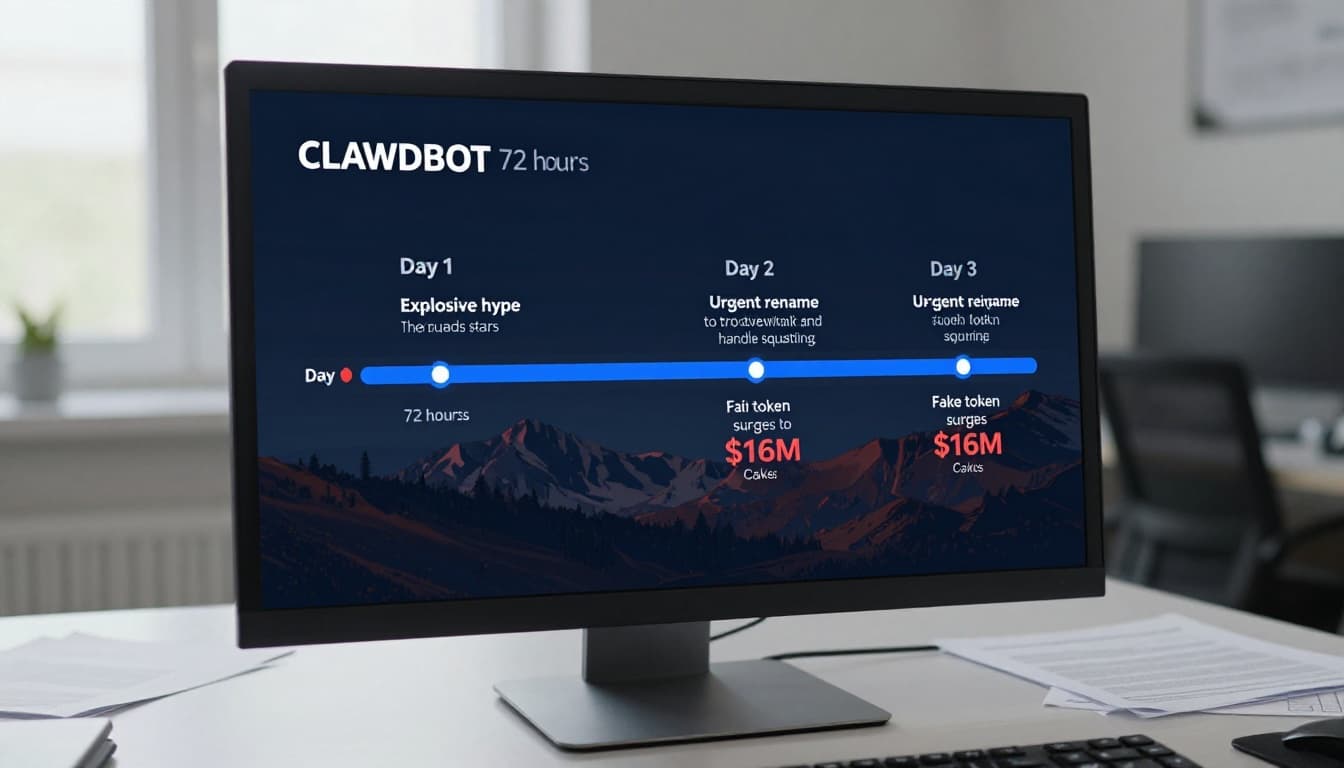 An at-a-glance timeline of how a viral AI project can spike, wobble, and collapse fast, created with AI.
The “AI assistant with hands” idea, memory plus integrations plus action
An agent feels different from a chatbot for one reason: it can do stuff. If you tell a normal chatbot “book me a flight,” it gives tips. If you tell an agent “book me a flight,” it can open the travel site, search dates, and complete steps.
CLAWDBOT promised that kind of “hands” ability plus persistent memory, plus integrations across apps people actually use (WhatsApp, Telegram, Slack, Discord, iMessage, Signal). Put that together and you get something that sounds like a personal operator. Not just answers, but outcomes.
It also sits right in the bigger shift toward agentic tools. If you want context on where this is heading (and why people are so eager), this piece on 2026 AI agent predictions captures the direction well.
Why GitHub stars and viral tweets are not safety checks
Here’s the uncomfortable truth: GitHub stars measure excitement, not security. A star is not a code review. It’s not a penetration test. It’s not even “I installed this.”
When something moves at hype-speed, verification becomes socially awkward. People don’t want to be the cautious one asking boring questions while everyone else is posting screenshots. That speed is also perfect cover for scammers. They don’t need months to infiltrate a community, they need 15 minutes and a believable profile picture.
The 72 hour meltdown, step by step, from a rename to a $16M scam wave
This didn’t implode because one bad actor showed up. It imploded because chaos creates openings, and the internet is full of people who profit from openings.
One trigger was naming. The project’s name sounded uncomfortably close to “Claude,” which is closely associated with Anthropic. Reports say legal pressure landed, the community scrambled, and a fast rebrand decision followed. That moment, the “we have to rename right now” moment, is when identity becomes fragile.
Not long after, scammers piled in. Handle squatters grabbed names the second they appeared. Fake “official” accounts popped up. A fake token launched and spread while many people were still trying to figure out what the new name even was.
 A “too-late” moment many buyers experience, the chart pumps first, warnings come after, created with AI.
The name change that opened the door to impersonators
Attackers watch for brand confusion the way surfers watch for waves. The instant a rename gets announced publicly, bots can snipe handles, domains, and lookalike accounts. In the CLAWDBOT story, handle squatters allegedly posted wallet addresses and tried to extort money. That’s not random trolling, it’s a playbook.
A rename also breaks the average person’s ability to verify. If yesterday you trusted “X,” and today it’s “Y,” you’re suddenly dependent on whatever link you saw most recently. Scammers win that race by being first, loud, and confident.
How the fake token took off before most people even understood what happened
The fake token mechanics are old, but they keep working: claim it’s “official,” push urgency, let the price pump, then dump. People buy because they want to be early, not because they’ve verified anything.
Coverage of the incident described a token hitting roughly $16M market cap before dropping around 90% after warnings, with the value falling below the million-dollar range (figures vary by tracker and timing). A quick summary is reported in Fake ‘ClawdBot’ AI token skyrockets to $16M.
The part that sticks with me is how fast “I saw it on Twitter” turns into “I just bought it.” No one thinks they’re the mark. They think they’re early.
The identity mess: hijacked accounts, fake GitHub profiles, and trust abuse
Alongside the token, there were reports of fake GitHub profiles claiming authority, even titles like “head of engineering,” plus convincing posts that looked like normal updates. Sometimes scammers don’t even create new accounts, they hijack abandoned ones because old accounts look legitimate.
This is why the platform itself becomes part of the con. GitHub, Discord, Twitter, they all feel familiar. Familiar equals safe in our brains, even when it shouldn’t.
If you want a broader view of how fast open agent projects are spreading (and why scams like this will repeat), this breakdown of an open source AI agent breakthrough helps frame the bigger trend.
The part that should scare you most, full system access and exposed keys
The money story is dramatic, but the scarier story is quieter: permissions.
CLAWDBOT-style agents weren’t just asking for access to one app. The big promise required deep access. Full system access can mean reading files, scanning folders, touching browser sessions, seeing saved passwords, opening photos, pulling private messages, even acting inside banking tabs if your machine is already logged in. That’s a lot of trust to hand over to software you found during a hype spike.
And even if nobody is “scamming” you, the setup itself can go wrong. Reports around this incident included misconfigurations that exposed API keys and other sensitive data, basically turning private instances into public ones. One discussion of banned accounts and exposed instances is captured in Why Clawdbot users are waking up to banned accounts.
A simple way to think about permissions, would you give a stranger your laptop
I use a basic gut check: if a tool asks for full access, imagine it as a person. Would you hand a stranger your unlocked laptop, walk out of the room, and say “just book my flight and don’t touch anything else”?
That’s what “full system access” is, in human terms. The agent might be well-meaning code. But if it gets compromised, or if you install the wrong fork, or if you connect it to the wrong service, the blast radius is your entire digital life.
Why messy computers make AI agents more risky, not more helpful
Most of us don’t have clean machines. We have five versions of the same PDF, folders named “final,” “final2,” “final_really,” and old tax docs sitting next to memes. An agent searching your drive can easily grab the wrong file, or misread context, or send something you didn’t mean to share.
People talk about hallucinations like they’re just funny mistakes. In an agent, hallucinations are more like confident mistakes with real consequences. When the tool can act, a wrong guess isn’t harmless.
API key leaks 101, what went wrong and what it can cost you
An API key is basically a secret password that lets software use a service on your behalf.
When keys leak, the damage is boring and painful: surprise bills from usage you didn’t authorize, access to connected tools, data pulled from integrations, sometimes full account takeover. Keys often leak through simple stuff, a misconfigured server, logs pasted into public threads, secrets committed to public repos, or a “quick test” setup that never got locked down.
The fix isn’t magical. It’s habits: keep keys in a secrets manager, avoid long-lived keys when possible, rotate keys after experiments, and separate “test” from “real” accounts.
What I learned from watching this unfold, and how I would protect myself next time
I’m writing this as Vinod Pandey, and honestly, watching the CLAWDBOT mess play out felt like standing near a busy road and seeing a pileup happen in slow motion. People weren’t stupid. They were excited. They wanted that one tool that finally makes AI feel useful, not gimmicky.
The first lesson that hit me was permissions. The moment a tool wants full system access, I slow down. Not later. Right then. Capability and risk rise together, so I can’t treat access like a pop-up I click through.
Second, “too good to be true” claims are a smell, not proof. Memory across everything, 50-plus integrations, do-anything actions, it might be possible, sure, but it also means the tool is sitting in the center of your life. That’s not a small experiment.
Third, unclear ownership and liability matters more than people want to admit. If something goes wrong, who do you contact? Who’s accountable? Where does your data live? When those answers are fuzzy, you’re basically agreeing to be your own security team.
Fourth, hype-driven adoption is not a comfort. A project getting tens of thousands of stars fast is a signal of attention, not safety. If anything, it means scammers are already inside the crowd.
Fifth, I’d start small, every time. If I really wanted to test an agent, I’d run it in a sandbox environment, on a separate computer profile, with a separate browser profile, and with throwaway accounts first. Not because I’m paranoid, but because I like my files and my money where they are.
And last, I’d verify official channels before downloading anything. I’d cross-check the maintainer’s account history, confirm announcements match across platforms, and ignore any “token” talk unless it comes from a clearly verified source. Even then, I’d wait. The internet punishes speed.
Conclusion
The AI boom is real, and tools like CLAWDBOT show why people are hungry for assistants that actually act. But the same hype that builds a community overnight can also build a trap overnight.
Keep it simple: verify identity, limit permissions, separate risk, and slow down when everyone else is rushing. Share this story with the friend who installs every new AI tool at 2 a.m., and do one concrete safety step today, like rotating API keys or setting up a sandbox account. In 2026, basic caution is a superpower.


0 Comments