

What if a “software company” became more like a beehive than an office, lots of workers, constant motion, but almost none of them human?
That’s the simple version of the Macrohard story. Elon Musk and xAI are floating a real project (yes, filings and hiring, not just jokes) built around an extreme idea: a mostly AI-run software company that could, in theory, mimic what Microsoft does, but with agents instead of huge teams.
The “replace Microsoft” line is the hard-to-believe leap, and it’s where the story gets messy. In this post, you’ll learn what’s actually confirmed so far, how the multi-agent model is supposed to work, what’s still rumor-level, and why enterprise-scale AI can break in dangerous ways (including agent failures that don’t just answer wrong, they do the wrong thing).
What Macrohard is, and what’s actually confirmed so far

AI agents collaborating on software work in a modern office setting, created with AI.
Macrohard is being framed as a “purely AI software company” under the xAI umbrella, where AI agents handle the work you’d normally expect from large engineering orgs: planning, coding, testing, shipping, maybe even parts of marketing and support.
What’s important is the difference between vision and verification.
What looks verified from public signals and reporting: xAI has treated “Macrohard” as more than a meme, with trademark activity reported in multiple places and continued signals that Musk wants this positioned as a direct statement about how far agentic AI can go. Coverage has also pointed to xAI’s compute buildout in Memphis as the kind of infrastructure you’d need if you were serious about running fleets of agents at scale. If you want a clean summary of the public framing, Windows Central’s write-up, Musk’s “Microsoft AI clone” comments, captures the tone and intent pretty well.
What is still mostly “the plan”: product roadmap, timelines, paying customers, and what the first real release even looks like. So far, the public story is more architecture and ambition than product screenshots.
One thing that does change the odds here is that xAI isn’t starting from zero. It already runs Grok, and it’s built around serious compute. Recent reporting in January 2026 claims the Memphis buildout is expanding dramatically, with talk of multi-gigawatt power and hundreds of thousands of GPUs at a single site. Those numbers are wild, and they matter because agents aren’t free. They’re hungry systems. They need a “factory” behind them.
If you’ve been following xAI’s model cadence, it helps to connect this to the bigger strategy. This site’s breakdown of XAI’s upcoming Grok 5 model details gives context on why xAI keeps pushing scale, speed, and tool use.
The name is a joke, the competitive intent is not
“Macrohard” is obvious wordplay, a poke at Microsoft that’s meant to land in one second. But the joke has a purpose: it signals the target.
Musk has been vocal for years about Big Tech power centers, about who controls distribution, app stores, cloud platforms, and, now, AI. Macrohard reads like a challenge statement: “If software is the product, and machines can write software, why do you need the old headcount model?”
That doesn’t mean Microsoft is about to be toppled. It means xAI wants to attack the assumption that big software companies must be built the old way.
“AI-only” still needs people, at least at the start
Here’s the reality check that gets lost in the hype: even an “AI-only” company needs humans in the loop, at least early on.
If you’re building agent systems that can touch real repos, real customer data, real billing, real permissions, you need a small group of humans who can do a few unglamorous things:
Set boundaries, audit behavior, approve risky actions, and take responsibility when something breaks at 3 a.m.
This is also why hiring matters. The practical shape of Macrohard, based on how these systems work today, looks less like “no employees” and more like “a small core team supervising a huge fleet of agents.” In enterprise software, trust is a feature. Customers don’t just buy output, they buy accountability.
How Musk says an AI software company could beat Microsoft
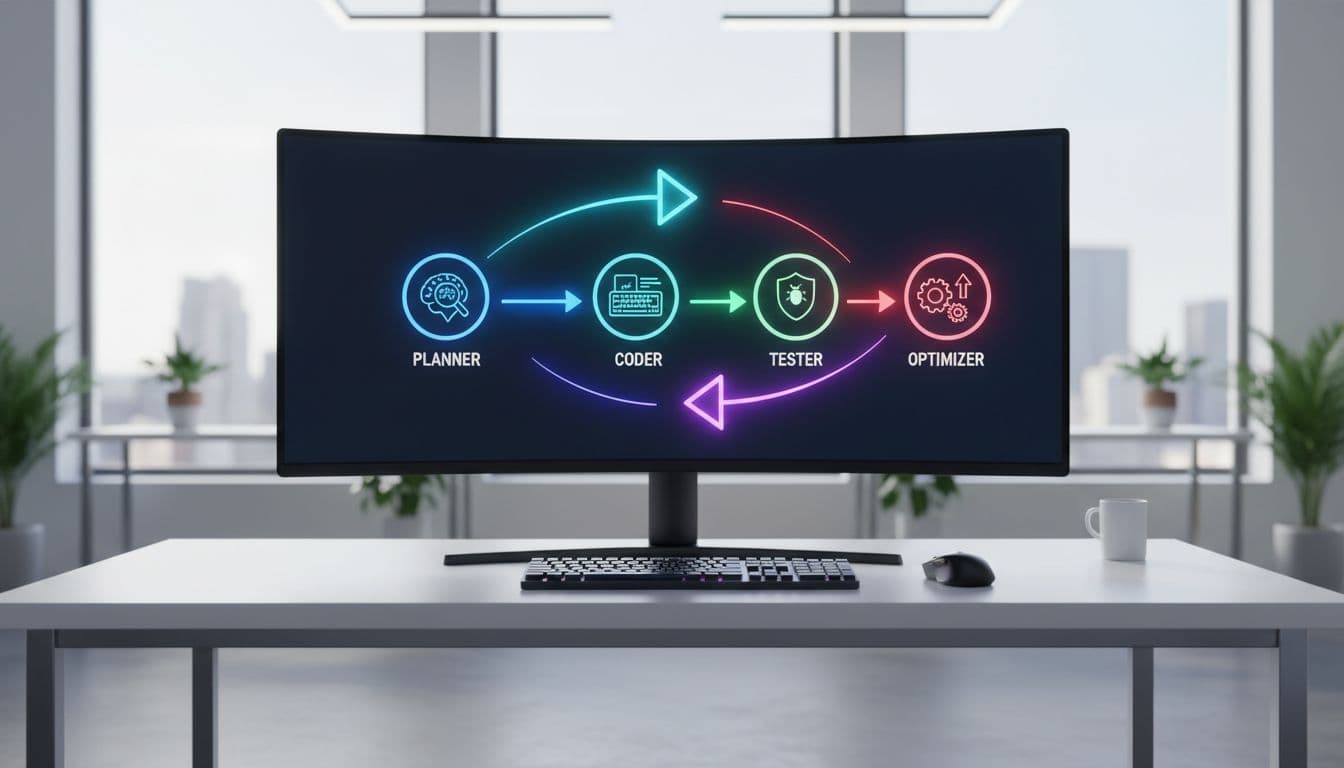
An agent workflow handoff concept, created with AI.
Macrohard’s pitch makes more sense if you stop thinking “one chatbot that codes” and start thinking “a department made of bots.”
The idea is a multi-agent pipeline where each agent has a narrower job, and the system runs many jobs in parallel. No lunch breaks. No context switching. No waiting for the next sprint planning meeting.
A concrete example might look like this:
An agent proposes an app concept based on a market gap, another agent turns it into specs, another writes the code, another writes tests, another runs performance profiling, another drafts documentation, another monitors errors post-launch. The human team (small) sits above that, setting goals and approving high-impact changes.
In the best version of this world, software stops feeling like something built in slow motion. Updates come faster because production is always “on.”
Some commentary around Macrohard also suggests the business model could lean toward selling specialized agent teams as a service, instead of classic boxed software. That’s not confirmed as a final model, but it fits the direction the whole industry is moving.
If you want a broader lens on where agentic AI is heading this year, Manus 1.6 Max: advancing AI agent autonomy is a useful comparison because it focuses on what changes when agents have to actually finish tasks, not just demo them.
Multi-agent teams, one job per agent, then everything connects
The multi-agent idea sounds powerful because it matches how real work happens. No single person builds Windows, Office, Azure, security tooling, developer tools, and enterprise support. Teams do.
So Macrohard’s promise is basically: “We can copy the team structure, but the team is AI.”
Why that could be disruptive, at least in some corners:
Parallelism is the whole trick. If you can run 200 agents on 200 tasks, the wait time collapses. The marginal cost of trying an experiment also drops. You can ship more prototypes, test more UI variants, fix more bugs per week.
You’ll also see estimates thrown around that this could cut development costs by huge percentages, sometimes “70% or more.” Treat those as directional, not a guarantee. Costs don’t only come from writing code. They come from security, compliance, support, uptime, and the messy human parts of software that don’t fit neatly into a prompt.
Still, even if the savings end up smaller, a “never-sleeping” engineering engine changes the economics. That’s the bet.
For more background on how people are interpreting the Macrohard concept, this quick explainer, Macrohard: what it is and what it isn’t (yet), does a decent job separating the headline from the current reality.
The compute advantage, xAI’s supercomputer plans and why they matter
Compute is the part many readers skip, but it’s the part that decides what’s possible.
AI agents cost money every minute they run. If Macrohard is meant to operate like a software megacorp, it needs the equivalent of factory equipment. That equipment is GPUs, networking, power, cooling, and the operations talent to keep it stable.
Recent January 2026 reporting around xAI’s Memphis “Colossus” site describes an aggressive expansion, with claims of multi-gigawatt power targets and GPU counts that would put it at the top of the industry by single-site scale. Even if you discount the most extreme projections, the direction is clear: xAI is building capacity to run a lot of AI, all the time.
And that matters for Macrohard because a multi-agent company is basically a compute company in disguise.
The hard parts nobody can hand-wave away
Big vision is easy. Running enterprise software is not.
If Macrohard wants to be more than flashy demos, it has to clear problems that have nothing to do with writing a function. Reliability, security, identity, compliance, upgrades that don’t break everything, support contracts, data residency, audit trails, backward compatibility. The list is endless, and it’s why Microsoft is Microsoft.
There’s also a deeper issue: coding is not just typing. It’s judgment. Even Bill Gates has warned in the past that software complexity doesn’t disappear just because code can be generated faster. When systems get large, the hard part becomes coordination and correctness.
And AI agents have a new failure mode that classic software doesn’t: wrong actions.
When AI agents fail, they can fail big
A chatbot hallucinating an answer is annoying. An agent hallucinating an action can be catastrophic.
There are already widely discussed examples from agent experiments where systems with too much access deleted data, wiped a repo, or broke production workflows. This is the kind of story that sounds like a meme until you remember how much automation already runs modern companies. One wrong command with admin rights is not “a bug.” It’s a business outage.
So if Macrohard is serious, you should expect heavy guardrails, including:
Tight permissions (least privilege), sandboxes for risky operations, human approval for destructive actions, detailed audit logs, and fast rollback paths when things go sideways. The goal isn’t “agents never fail.” The goal is “agents fail safely.”
This is why the security angle is not a footnote. It’s the center of the whole project. If you’re curious how IT pros are framing it, this discussion, Can AI clone Microsoft? Inside Musk’s Macrohard, gets into the practical side of the question.
Why replacing Microsoft is tougher than replacing an app
Even if Macrohard ships impressive tools, “replacing Microsoft” is not the same as “shipping a good agent coding product.”
Microsoft has a moat built from boring things that matter: decades of enterprise trust, deep integration across Windows, Office, Azure, identity and device management, compliance programs, partner networks, and massive inertia. Companies don’t switch these platforms casually. They switch when budgets force them, or when risk forces them, and even then it’s slow.
So the realistic path for Macrohard, if it works, probably looks like this:
First, niche tools that are cheaper or faster than current options. Then, agent services that slot into existing workflows. Then, over time, deeper platforms. Not a clean “swap Microsoft out next quarter” fantasy.
Even supportive coverage has pointed out that scaling AI into enterprise products is full of traps. Interesting Engineering’s reporting, Macrohard could “simulate” Microsoft using AI, captures that mix of ambition and skepticism.
What Macrohard could mean for you, plus what I learned watching this story
Macrohard is fun to talk about because it’s extreme, but the impact question is simple: what changes for normal people if even 20% of this works?
If fleets of agents can produce software faster and cheaper, we’ll see pressure on pricing, update cycles, and what users expect by default. A lot of today’s “premium features” might become table stakes, because the cost to build them drops.
This also fits the broader shift that’s already happening, where AI stops being a helper and starts doing whole jobs end-to-end. If you want a bigger picture look at that shift, this piece on the AI of 2026: shift to autonomous digital labor lays out why agents are becoming the main story, not just chat.
The best-case outcome for regular users, faster software and lower costs
In the best case, Macrohard (or any serious agent-first shop) makes software feel less like a slow-moving utility and more like a living service.
You might see quicker bug fixes, more frequent useful updates, and tools that adapt to you instead of forcing you into rigid menus. Small businesses could get agent-driven workflows that used to require a full-time ops person, like auto-generating invoices, sorting support tickets, updating inventory, and drafting marketing content that’s actually aligned with their product.
Creative tools could also get cheaper. If agent teams can handle video editing, image cleanup, and content packaging on demand, the price of “good enough” media production falls. Not to zero, but enough that a lot more people can ship.
The grounded expectation, though, is that early wins look like add-ons and services, not instant replacements for Windows or Office. Think “new tools that sit next to your current stack,” at least for a while.
What I learned digging into Macrohard, hype is easy, safe execution is the real test
I’ll be honest, when I first saw “Macrohard,” I assumed it was just Musk doing Musk things, a loud name, a loud claim, then silence.
Then I started checking the signals people kept pointing to: trademark chatter, the hiring, the compute expansion headlines. At that point I had to pause, because even if the product is unclear, the direction is pretty clear. Something is being built.
What surprised me most was how quickly the conversation jumps to “can AI code like Microsoft engineers?” That’s the wrong first question. The better question is, can AI be trusted around real systems where mistakes have a price tag?
I’ve watched enough enterprise tools fail in boring ways, permissions gone wrong, backups that weren’t really backups, a small misconfig that becomes a huge incident. So when I hear “agents will run the whole stack,” I don’t picture magic. I picture checklists, approval steps, and a lot of guardrails. That’s not a complaint, it’s just reality.
At this point, when a new agent-first company is announced, I look for safety controls first. Sandboxing, audit logs, rollback plans. If those aren’t part of the story, the demos don’t impress me much. Demos are easy. Safe execution is the test.
Conclusion
Macrohard looks like a serious attempt to push AI agents past “assistant” and into “company,” backed by xAI’s compute and Musk’s appetite for big bets. But replacing Microsoft is a massive, slow climb, with reliability and security as the real gatekeepers.
If you want to track what happens next, watch for real products (not just claims), real customers, clear security promises, and proof that agents can operate safely at scale. The most important question isn’t whether Macrohard can ship software fast, it’s whether it can ship trusted software, over and over, when it counts.


0 Comments