

Picture a humanoid robot squeezing itself smaller, like someone holding their breath to slip through a tight gap. Then it stretches taller again, almost like it “grows” bones on demand. A moment later, it’s light enough to float, and weirdly, it can step across water without sinking right away.
That robot is Grow HR, shown by researchers in Shenzhen at Southern University of Science and Technology (SUSTech). It’s not a polished product you can order, and it’s not a promise that tomorrow’s robots will all be soft and stretchy. But what they’ve demonstrated is still hard to ignore because it hints at a different future for the AI Robot body, not just the AI brain.
And the timing matters. China isn’t only showing unusual lab demos, it’s also ramping up factories, supply chains, and fleet deployments. So a strange prototype in January 2026 doesn’t just stay a prototype forever. Sometimes it becomes a category.
Meet Grow HR, the shape-shifting AI Robot built like a living skeleton
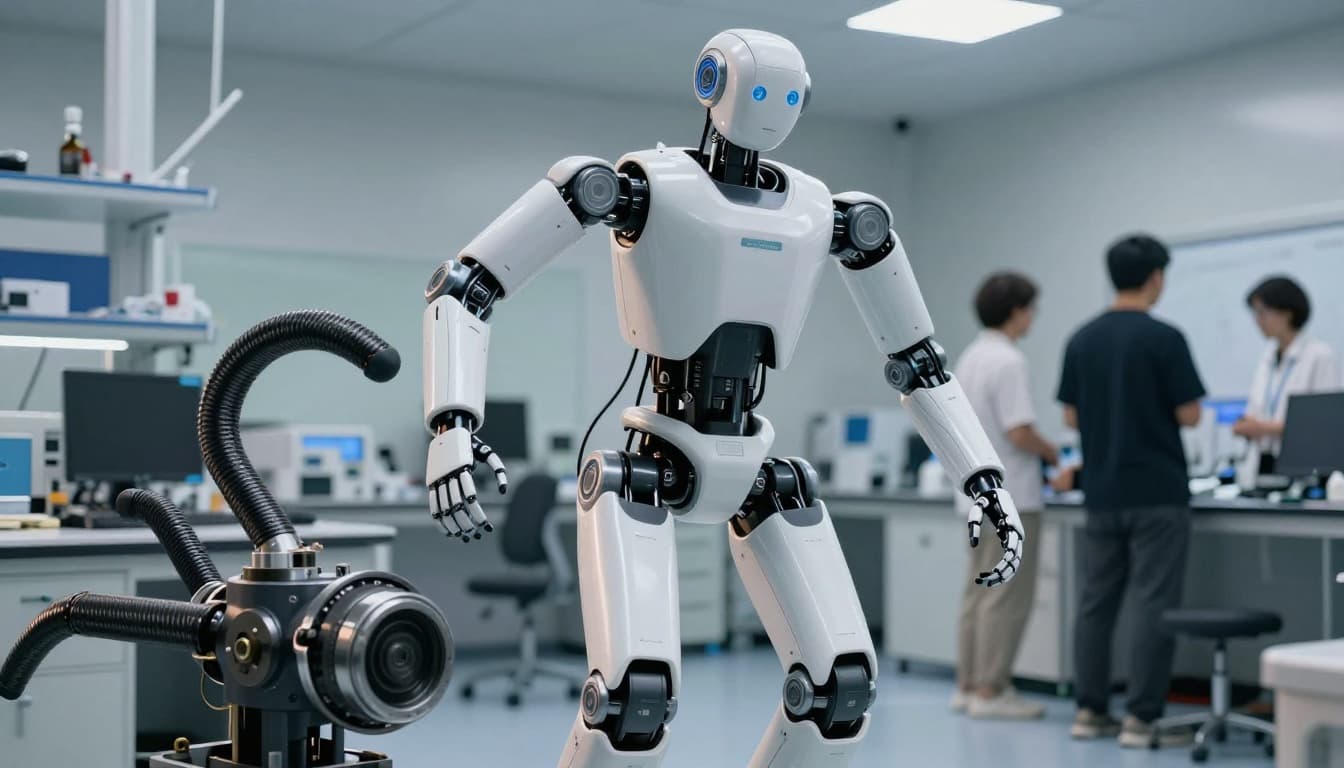 Grow HR expanding in a lab setting, showing the “growable skeleton” idea, created with AI.
Most humanoid robots you see online are built like metal athletes: rigid frames, hard joints, and a body that stays the same size all day. Grow HR starts from a different question: what if a humanoid’s “skeleton” could change shape on purpose, while still staying usable?
The team’s approach is inspired by how bones do more than one job at once. Bones are stiff, but also structured to absorb shocks and stay lightweight. Grow HR borrows that logic using bone-inspired growable linkages. Each linkage blends soft expandable chambers (think controlled expansion, not party balloons), tensioned cables, rigid adapters, and a non-stretch textile layer that adds stiffness along the length.
The numbers are what make it feel real. The linkages can extend up to 315%. The robot can increase its height by about 278%, reaching around 1.36 m when fully stretched. Then it can compress again, shrinking its height by about 36% and its width by about 61%, which is exactly the kind of change that matters in cramped spaces. Even better, it stays light: roughly 4.5 kg (about 9.9 lbs).
Also, this wasn’t framed as a cute one-off stunt. The work was published in Science Advances, which is one reason it’s being taken seriously, even outside China. If you want a plain-language breakdown of what’s been shown so far, this report is a solid starting point: coverage of Grow HR’s grow-and-shrink demo.
How it changes size without turning into a floppy balloon
Soft robots often have one big problem: once you inflate or bend them, they can lose their “useful shape.” Grow HR avoids that by treating expansion like a guided motion.
The tension cables act like internal reins, and the non-stretch fabric helps stop random bulging. So the robot can expand smoothly and still hold a structured form. The researchers also mix soft and stiff parts, including telescopic pieces (they’ve mentioned carbon fiber elements for stiffness and balance). That hybrid build is the quiet trick here. It’s how the robot stays controllable instead of wobbling like an air mattress.
Why shape-shifting matters more than raw strength in the real world
When people picture rescue robots, they often imagine brute force. Lift the beam, clear the wall, drag someone out. Real scenes are usually messier. Narrow gaps. Jagged debris. Low ceilings. Tight corridors. A rigid humanoid can be strong and still fail because it can’t physically fit.
A PhD student on the project, Wong Ting, pointed out that this kind of growable body could be useful in field rescue missions, where the job is basically “don’t get stuck.” That’s a simple goal, but it’s brutal in practice. If a robot can shrink its width by more than half, then re-expand once it’s through, you’ve removed a huge bottleneck.
Walking on water, swimming, crawling fast, and the truth about “flying”
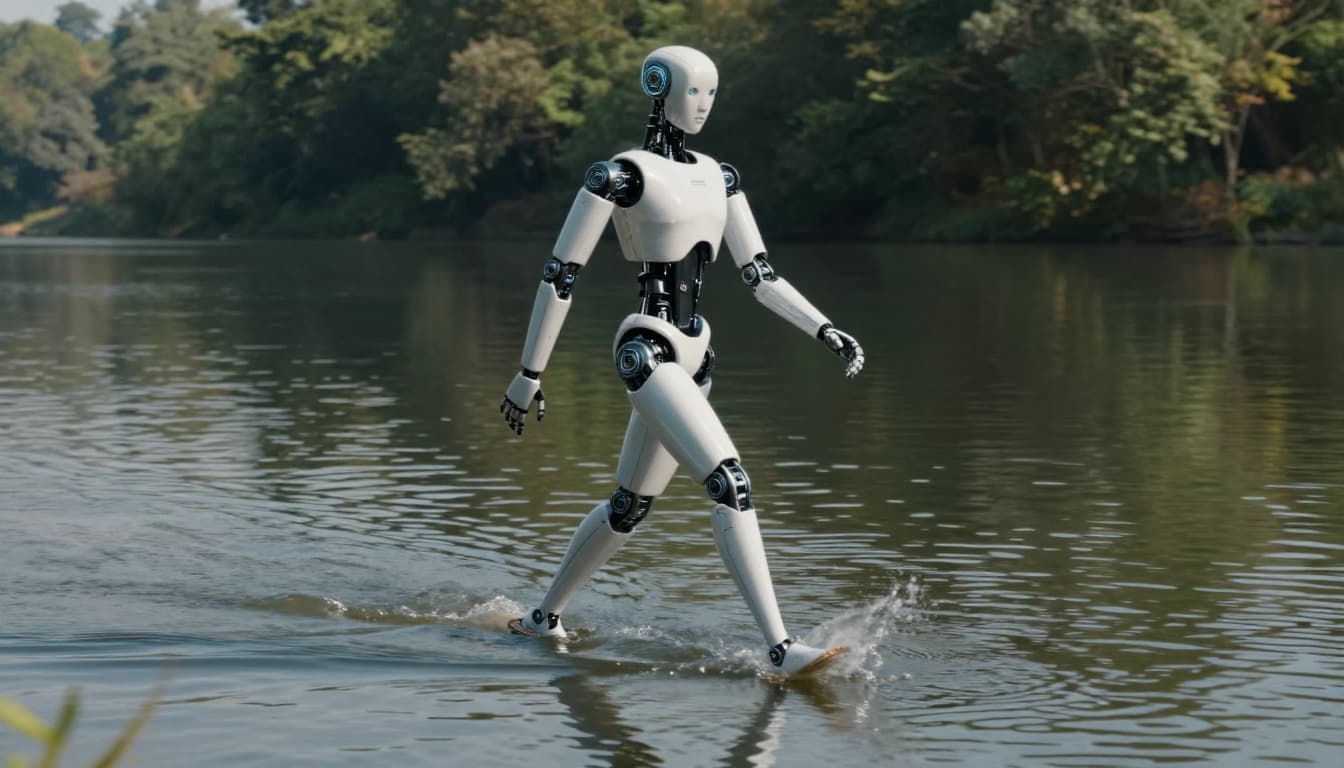 A concept-style view of a lightweight humanoid stepping across water, created with AI.
The headlines say “walks on water, swims, flies.” The fun part is that the team really did show multiple modes, but each mode has its own conditions and limits. That’s where the story gets more interesting than the headline.
Crawling is a good place to start because it sounds boring until you see the details. The team reports crawling at about 112.2 mm per minute in one mode. Then comes the bigger claim: when the robot coordinates its growth-style actuation with joint motors, crawling becomes over 1,000 times faster than using either method alone (they describe it as 1,122 times faster). That’s not just “it can change shape,” it’s “shape change can amplify movement.”
Floating and swimming are mostly about physics and weight. At around 4.5 kg, Grow HR is light enough that water mobility becomes possible without complex buoyancy hardware. It can float, and it can swim. Soft bodies also tend to handle impacts better, which matters when you’re bumping into rocks, edges, and submerged junk.
Walking on water is the one that makes people pause. The team reports about 16 mm/s for water-walking. That’s not sprinting across a lake like a movie. It’s more like careful stepping across the surface, using low weight and foot-water interaction to avoid breaking through immediately. Still, it’s a rare demo for a humanoid platform.
Now the “flying” part. Grow HR doesn’t have hidden jets. The point is that the platform is so light that if you attach ducted fans or a quadrotor module, it can be lifted and moved through the air for short distances. That’s a different claim, and a fair one. Lightweight bodies open doors that heavy humanoids just can’t.
For another summary of these modes, you can check this write-up: GrowHR floats, swims, and walks on water.
The cool part is not one trick, it is switching modes when terrain changes
The real world doesn’t stick to one surface. A rescue scene can go rubble, then mud, then shallow water, then stairs, then a tight hallway. Most humanoids are still happiest on flat indoor floors. They can walk, sure, but once you add water, gaps, or unstable debris, the “human shape” becomes a weakness.
Grow HR’s story is about mode switching. Crawl when the ceiling is low. Shrink when the gap is narrow. Float when the ground disappears. Then stretch taller again when you need reach, visibility, or a longer stride. It’s not magic. It’s just a body that’s willing to change its plan mid-task.
China’s humanoid robot wave: from lab demos to factories and fleets
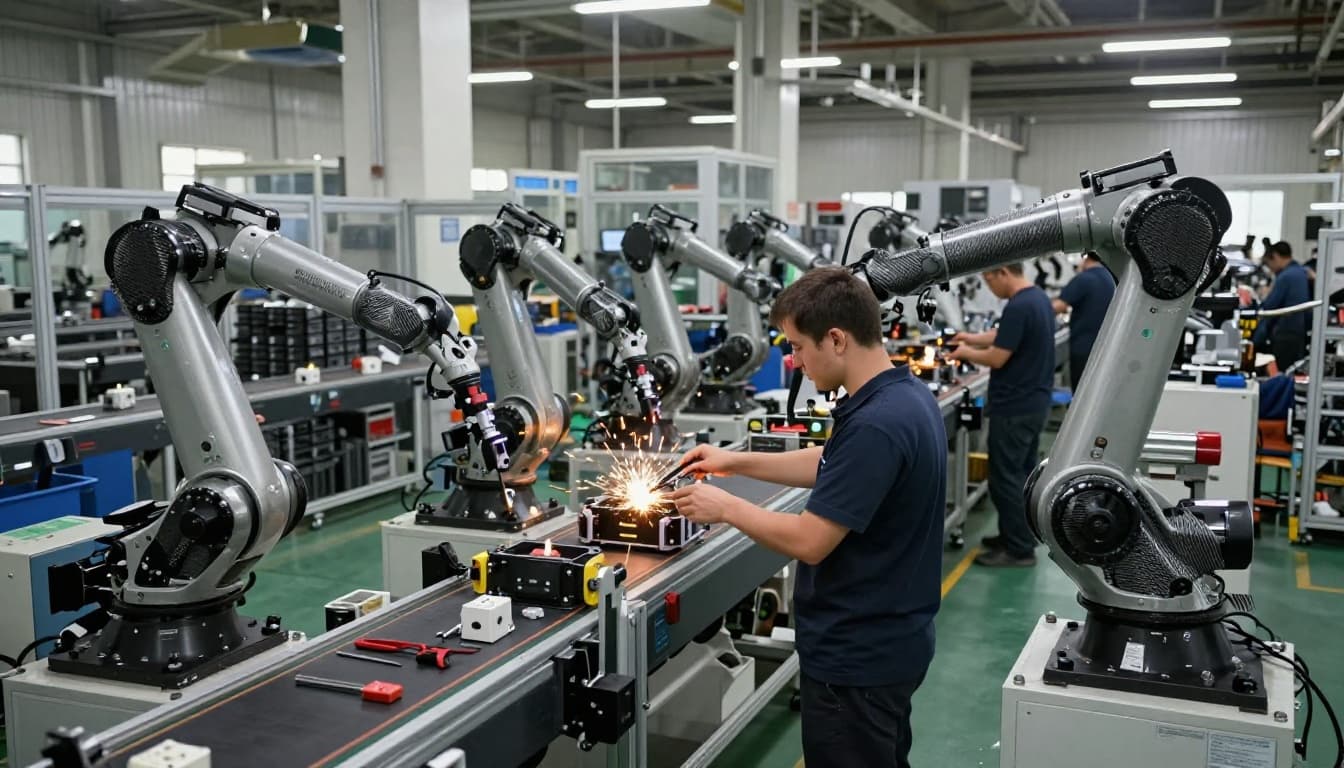 A factory-style scene showing how humanoid parts could be produced at scale, created with AI.
Grow HR is a lab robot, but it’s landing in a country that’s getting serious about manufacturing humanoids like an industry, not a science fair.
One big piece is components, not full robots. China has opened a large facility in Shanghai focused on humanoid robot joints, with a target of about 100,000 joints per year, and plans to triple output. That matters because joints can represent around half of a humanoid’s cost. If you can mass-produce joints reliably, you can push prices down and speed up iteration.
Then there are the market numbers, which are starting to look less like “future forecasts” and more like “current business.” IDC estimates global humanoid shipments hit around 18,000 units in 2025, with roughly $440 million in sales and about 58% year-over-year growth. Unitree alone reported shipping about 5,500 humanoid robots in 2025, with about 6,500 produced, and Chinese companies reportedly account for over 80% of installations. One quick reference on Unitree’s shipments is here: report on Unitree’s 2025 humanoid shipments.
Zoom out again and you see the base layer: by the end of 2024, China reportedly had 451,700 intelligent robotics enterprises, backed by huge registered capital. That’s the engine behind the speed.
If you’ve been following this trend on AI Revolution, this earlier post connects some of the dots around scaling and pricing: China’s fast-moving humanoid robotics push.
From one robot to a team of robots: the 18-robot crate walkout demo
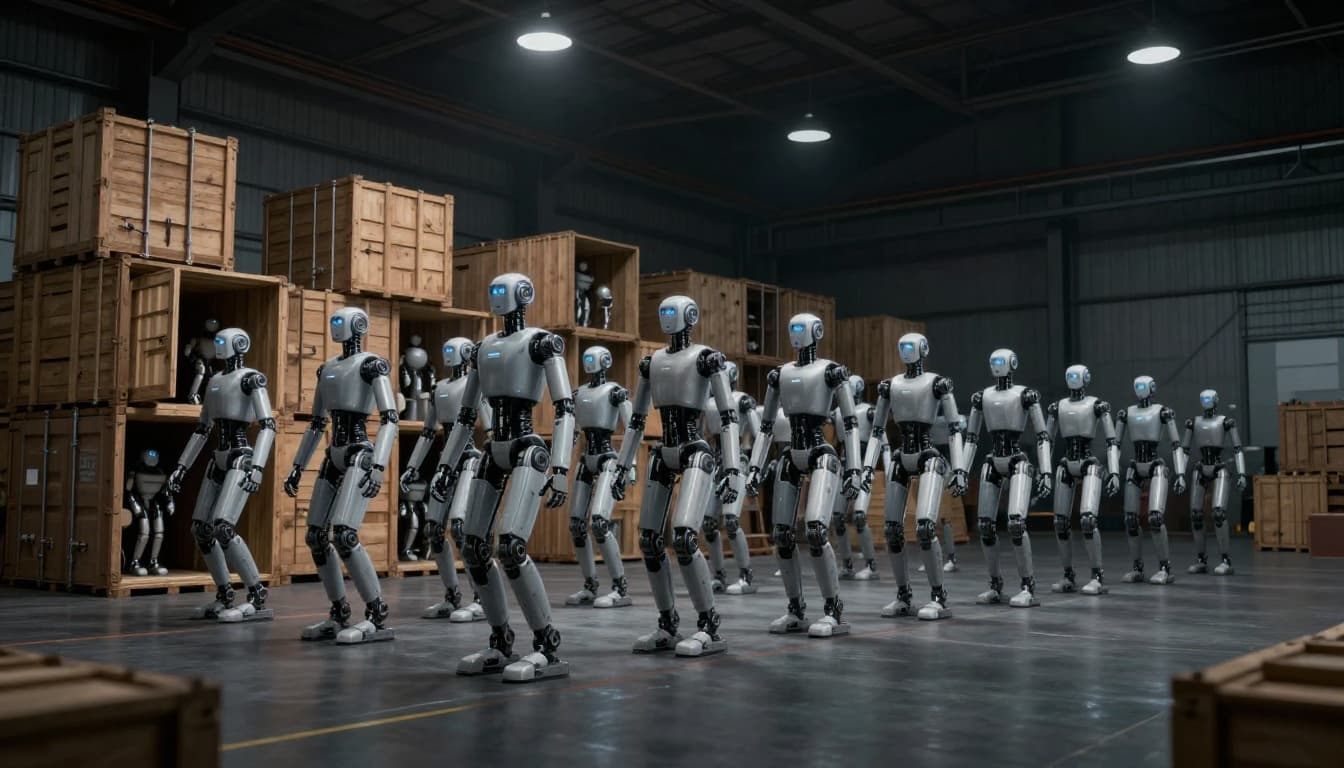 A fleet-style deployment scene with robots emerging from crates, created with AI.
A single robot is easy to love. A fleet is where things get hard. Batteries, startup routines, collision avoidance, coordination, and boring logistics.
Limx Dynamics (also in Shenzhen) showed a video of 18 Ali humanoid robots emerging from shipping crates, standing up, walking out, avoiding each other in tight space, then moving together in a coordinated routine. The setting matters: crates and constrained exits feel like real deployment, not a wide-open lab.
Limx ties this to its operating system, KOSA (they describe it as a cognitive OS for agents). In everyday words, it’s a shared control layer where perception, motion planning, memory, and fast balance correction work together so the group can behave like a coordinated unit instead of 18 machines guessing around each other.
If you want the company’s own overview, start here: Limx Dynamics official site. There’s also mainstream coverage of the crate demo here: humanoids walking out of crates.
Space and satellite links hint at where humanoids could go next
China’s humanoid story is also stretching upward. Engine AI’s PM01 is being positioned for a robot astronaut effort, which forces a different level of thinking: vacuum-like conditions, microgravity, radiation, and brutal temperature swings. On Earth, the commercial PM01 version has been discussed at around a $27,000 launch price, standing about 1.38 m and weighing about 40 kg, with an aluminum alloy exoskeleton and a waist rotation up to 320°.
Then there’s communications. Exhumanoid’s Tien Kung robot reportedly connected directly to a low Earth orbit satellite (without leaning on a ground network), streamed live video and motion data, and completed a small real task run. That kind of link matters when the network is down, or when you’re far from infrastructure. A quick summary is here: satellite-linked humanoid and space prep.
What I learned covering this, and what I would watch next
Covering robots like Grow HR has messed with my instincts a bit. I used to think the big breakthrough would be “stronger motors” or “better hands.” Those matter, yes, but the real pain point often shows up earlier. It’s the environment. Doors that don’t open fully. Debris that shifts underfoot. A gap that’s just 5 cm too narrow. In those moments, a shape-shifting body can beat a stronger one.
The other thing I’ve learned is to be careful with the “fly” headline. It sounds like sci-fi, but the more important point is lighter bodies. A lighter AI Robot can float, can carry extra sensors, and can be lifted by add-ons without needing a complete redesign. That’s not hype, it’s engineering economics.
And honestly, China’s advantage doesn’t feel like “better AI” on its own. It’s the boring stuff, supply chain depth, factories willing to scale parts, and a culture of rapid iteration. When that machine is running, unusual prototypes don’t stay unusual for long.
What I’d watch from 2026 to 2031 is pretty simple: durability in dust and rain, battery life that holds up outside demos, real rescue or inspection trials (not just controlled spaces), safety around people, and cost sliding down into the tens of thousands without cutting corners. If those boxes get checked, the shape-shifting idea stops being a cool clip and starts being a product category.
Conclusion
Grow HR is early, and it’s not going to replace rigid humanoids overnight. But it points to a new direction: bodies that can change shape on purpose, stay lightweight, and switch movement modes when the terrain stops cooperating. Pair that with China’s fast scale-up in parts and manufacturing, and you get a pipeline where today’s weird lab robot can become tomorrow’s standard platform.
The bigger question isn’t “can it walk on water?” It’s whether this kind of AI Robot body can survive real work, in real mess, for real hours. What would you trust it to do first, rescue, inspection, or something else?
Image placement ideas for this article: A lab-style scene of Grow HR expanding from compact to tall, showing soft skeletal linkages. A concept still of a lightweight humanoid stepping across calm water with visible ripples. A warehouse scene of multiple humanoids emerging from shipping crates and moving in formation. A factory scene focused on humanoid joint production and assembly lines with stacked components ready to ship.


0 Comments