

Factories, streets, and even furniture are changing in front of us. A factory robot with six arms is about to outwork human teams. A humanoid learned to walk in 48 hours. MIT showed a system that turns spoken words into real furniture. In China, an AI traffic cop is already managing real cars.
All of this is live, not theoretical. If you care about AI, work, or public safety, this is the moment to pay attention.
In this guide, you will see:
- China’s six-armed factory robot built purely for output
- A UK humanoid that went from design to walking in months, not years
- MIT’s speech-to-object pipeline that turns ideas into physical things
- Hangzhou’s AI traffic robot working on real streets
None of this is sci-fi, it is happening now.
Factories, Streets, And Robots Are Changing Fast
A quiet shift is happening. For years, AI mostly meant software: chatbots, image generators, recommendation engines. Now that same intelligence is moving into bodies that work, walk, and direct traffic.
The four stories in this post show that shift from different angles:
- Midea’s Miro U: a six-armed industrial robot that targets pure efficiency
- Humanoid’s Alpha: a bipedal robot that learned to walk in 48 hours using simulation
- MIT’s speech-to-object system: spoken intent turned into real, usable objects
- Hangxing No. 1: an AI “officer” active at a real intersection in Hangzhou
If you want more background on how robots are getting stronger, smarter, and cheaper at the same time, there is a deeper breakdown of how AI is giving robots new superpowers.
China’s Six-Armed “Superhumanoid”: Midea’s Miro U
At the Greater Bay Area New Economy Forum on December 5, Chinese home appliance giant Midea quietly rolled out something that looks like a turning point for factory work: the Miro U.
Why Miro U Breaks All The Usual Robot Rules
Miro U has a humanoid head and torso, so it lines up perfectly with existing human-height workstations. That matters, because factories do not want to rebuild their entire floor layout just to add AI robots.
From there, the design takes a hard turn away from human imitation.
Instead of two arms, Miro U has six fully actuated bionic limbs. The robot runs on a wheeled base, not legs, which instantly removes the hardest part of humanoid robotics: balance. Wheels give it fast repositioning, high stability, and zero worry about tripping over cables or uneven floors.
On top of the base sits a vertical lifting column. That lets the robot raise or lower its body to reach different heights smoothly. A full 360-degree in-place rotation means it can spin, lift, reach, and swap tools without backing up or twisting its entire platform.

Wei Chang, Midea Group’s vice president and CTO, has been blunt about the philosophy. The goal is not to copy people. The value comes from leaving human mimicry behind and chasing real industrial efficiency.
At the launch event, he called Miro U a superhumanoid, and for once that term fits. This machine is built to outperform, not resemble.
If you want a closer technical overview and rollout details, this report on the world’s first six-armed humanoid robot is a solid reference.
How Miro U Outworks Human Teams
Miro U’s six limbs are not just for show. They split work by role.
- The lower limbs focus on heavy components, lifting and positioning them while keeping the robot stable.
- The upper limbs handle fine assembly, fastening, and other precision tasks in the same space.
That layout lets the robot run three tasks at once within one workstation. For example, it could:
- Hold a motor housing steady with one pair of arms
- Position a bracket with another
- Tighten fasteners with the remaining limbs
A few of the practical advantages:
- Roughly 30 percent faster changeovers on the production line once fully integrated
- One Miro U can replace what would usually take several workers or multiple different machines
- It slots directly into existing human-height stations, with no major retooling of the line
This is not a long-term concept. Miro U is scheduled for pilot testing in Midea’s high-end washing machine factory in Jiangsu Province within the same month as the launch.
That timeline matters. It shows how fast physical AI is going from stage demo to real work.
Midea’s Bigger Plan For AI Robots
Miro U is not a one-off experiment. It is part of a deliberate split in Midea’s robotics strategy.
The company now runs two separate humanoid tracks:
- Miro series
Industrial, high-output robots like Miro U. These focus on wheels, multiple arms, and tight integration with factory systems. - MEA series
Lighter-duty bipedal humanoids built for service roles in shops and homes. Midea plans to place these in its own retail stores by 2026 to guide customers, run demos, and interact with visitors.
Midea has been laying the groundwork for years:
- In 2017, it acquired German robotics company KUKA, which gave it deep industrial automation expertise.
- In 2022, it received approval to run a state key lab for high-end heavy-duty robots, plus the Blue Orange Lab.
- In 2024, it launched a dedicated humanoid robot innovation center.
Miro U is reportedly the third generation of Midea’s humanoid line. According to Wei Chang, it is the first robot in the world to surpass human physical limits while still fitting into human-designed workstations.
If you want a broader look at how other companies are shaping lifelike platforms, there is a related breakdown on new humanoid robots from Xpeng and Unitree.
UK Humanoid Walks In 48 Hours: Humanoid’s Alpha
While China tuned a six-armed robot for factories, a London startup called Humanoid hit a different milestone: speed of learning.
Their first bipedal robot, the HMND01 Alpha Bipedal, learned to walk in only 48 hours after final assembly.
From Design Sketch To Walking Robot In Months
Humanoid was founded in 2024. In its first public reveal, the company shared two striking numbers:
- The bipedal Alpha learned stable walking in two days, not the weeks or months typical for humanoid robots.
- The full journey from initial design to working prototype took five months, while many traditional projects take 18 to 24 months.
The trick is heavy use of simulation.
Humanoid trained Alpha’s locomotion in NVIDIA Isaac Sim and Isaac Lab, compressing roughly 19 months of conventional training into 2 days of virtual reinforcement learning. By the time the real robot stood up, it had already lived through millions of seconds of simulated experience.
In simulation, Alpha trained on more than 52.5 million seconds of locomotion data.
That is the new pattern for serious AI robotics: most of the struggle happens inside GPUs before a single motor spins in the real world.
For a deeper technical overview, this writeup on Humanoid’s Alpha walking in 48 hours is useful.
Specs That Make Alpha Ready For Real Work
On paper, Alpha looks like a practical mid-sized humanoid:
- Height: 179 cm (about 5 feet 10 inches)
- Payload: 15 kg in bimanual mode
- Joints: 29 degrees of freedom (not counting the end effectors)
Its hands are modular:
- Five‑finger dexterous hands with 12 degrees of freedom for fine tasks
- Simple 1‑degree-of-freedom parallel grippers for jobs that just need a firm grasp
The sensor stack is dense:
- Six RGB cameras plus two depth sensors in the head
- A six-microphone array for audio
- Haptic sensors in key touch points
- Force and torque sensors with joint torque feedback across the body
All this runs on NVIDIA Jetson Orin AGX hardware, paired with Intel i9 processors. Power comes from a swappable battery that gives around 3 hours of runtime, which is tuned for testing and shorter deployments for now.
Humanoid’s CEO, Ardam Sov, says Alpha can:
- Walk straight and along curved paths
- Turn in place, side step, squat, hop, and run
- Recover from pushes of up to 350 newtons
- Perform precise manipulation while staying balanced

The vision is broad. Humanoid wants Alpha working in industrial environments, service roles, and even domestic settings, including support for the elderly or people with mobility limits.
From Wheels To Legs: A Smart Path To Market
Alpha is not the company’s first robot. Before the bipedal design, Humanoid built a wheeled mobile manipulator also called HMND01 Alpha.
That decision was smart for several reasons:
- Wheeled robots reach market faster and use well understood safety patterns.
- Many factories and warehouses are flat and single-level, so legs are not needed.
- Most handled items in those spaces weigh under 15 kg, which matches the robot’s bimanual payload.
By starting on wheels, the team could separate balance problems from manipulation problems. They also designed subsystems to be modular from day one. The head, torso, and arms can move across platforms with minimal redesign.
That reuse is what cut their bipedal development time down to five months.
On the business side, Humanoid:
- Was founded in 2024
- Has raised 50 million dollars in founder-led capital
- Reports 19,500 pre-orders
- Has four completed proof-of-concept deployments and three more running
- Is fully booked for early 2026 pilot units
Safety is a core part of their pitch. The company emphasizes compliance with EU rules on machinery, electrical safety, EMC, radio, batteries, workplace health, and data protection. They also claim alignment with the EU AI Act and GDPR, positioning themselves as a careful second mover.
For a broader context on how other humanoids are talking, dancing, and handling stairs, you can explore this breakdown of humanoid robots that talk, dance, and climb stairs.
MIT’s System That Turns Speech Into Real Objects
While factories and humanoids are racing ahead, researchers at MIT are pushing AI into another frontier: instant physical creation.
Their new research prototype is described as a speech-to-reality system. You speak an idea, and a real object appears minutes later.
Speech-To-Reality: From Idea To Thing In Minutes
The concept is direct.
- A user verbally describes an object.
- The system interprets the request and designs a 3D structure.
- A robotic fabrication system builds the physical item.
This is not about digital renders. In tests, the system has produced:
- Functional furniture such as stools, shelves, chairs, and small tables
- Decorative items, including a dog statue that shows it can handle more complex shapes
Behind the scenes, the pipeline blends several AI and robotics layers:
- Automatic speech recognition
- A large language model that parses intent and constraints
- A 3D generative AI model that creates candidate structures
- Geometric processing that checks stability and manufacturability
- Robotic tools that cut, assemble, or print the final design
You can read more details in this overview of MIT researchers who “speak objects into existence”.
The Pipeline That Collapses The Gap Between Thought And Matter
The power of this system sits in how each part feeds the next. A typical request flows like this:
- You speak: “I need a small, sturdy stool that fits under my desk and holds 90 kilograms.”
- Language understanding: The model extracts constraints, such as height, width, weight capacity, and style hints.
- 3D generation: A structural model proposes one or more shapes that satisfy those constraints.
- Geometry checks: Algorithms test the design for balance, load paths, and material limits.
- Robotic fabrication: Machines cut or print the pieces and assemble the final object.
The result is a workflow that collapses the gap between idea and object.
The first impact will likely be in:
- Product design and prototyping
- Custom furniture and interior setups
- Small-batch goods where traditional tooling is too slow or expensive
The same way text-to-image models shortened creative timelines on screens, this kind of speech-to-object AI could do the same for physical products.
For a wider look at how synthetic materials and sensors are giving robots more human-like touch, there is a related deep dive into synthetic-skin humanoid robots and their capabilities.
What I Learned Watching AI Step Into The Physical World
Seeing all of these systems side by side changed how I think about AI.
First, form no longer predicts function. A “humanoid” can have six arms on wheels, or two legs with modular hands, and both can be valid if they solve real problems. The era of building robots just to look like people is giving way to machines tuned for output, safety, and cost.
Second, the speed of learning is shocking. A bipedal robot that learns to walk in 48 hours, after living through millions of virtual seconds, feels like a preview of how fast future AI systems will adapt to new tasks. The idea of spending months hand-tuning every movement is starting to feel outdated.
Third, the line between software and hardware is fading. MIT’s speech-to-object system is a perfect example. You speak, models reason, robots build. That is not just automation. It is a new kind of “conversation” with the physical world.
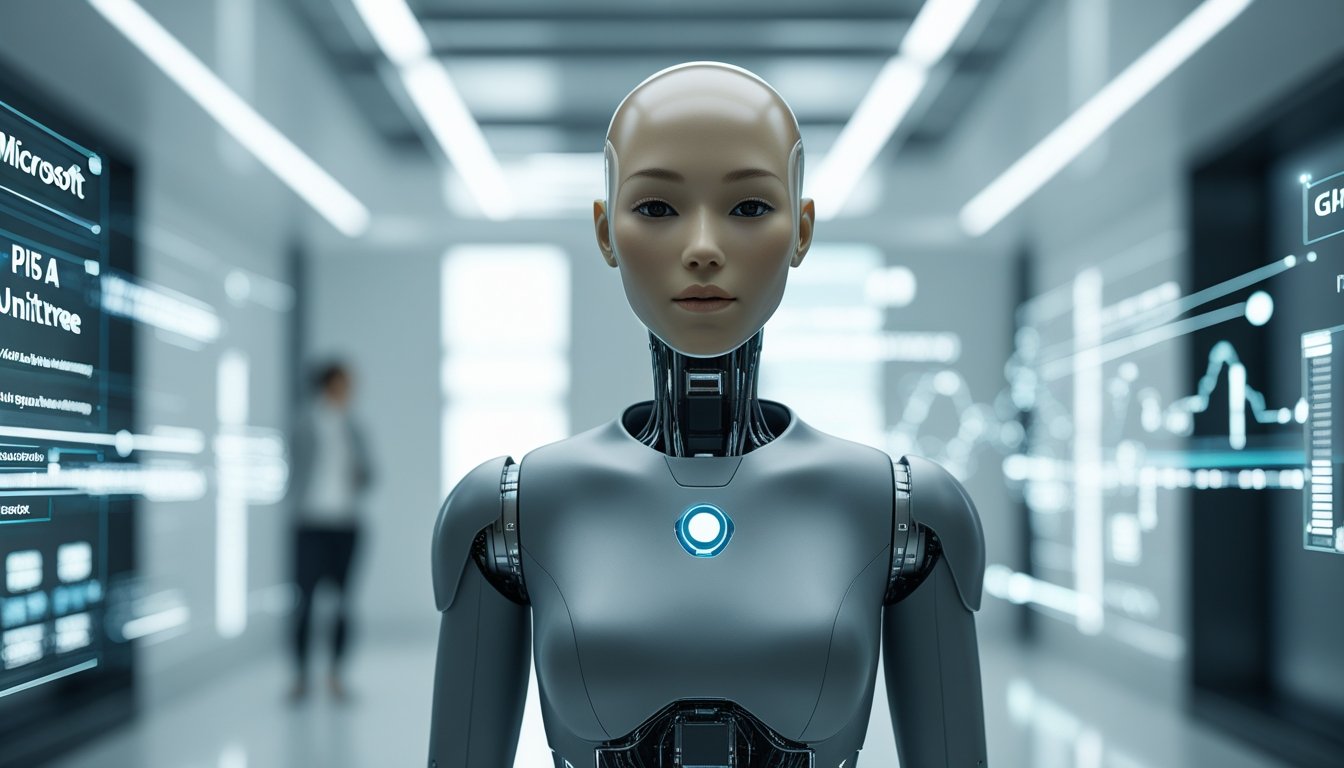
Finally, public deployments like Hangzhou’s traffic robot are a reminder that social trust will matter as much as technical specs. It is one thing to watch a humanoid in a lab. It is very different to have an AI system telling you when to cross the street.
If you want a snapshot of just how wild one recent week in humanoid news looked, including wins and failures, take a look at this review of recent highlights in humanoid AI developments.
AI Traffic Cop Hits Real Streets In Hangzhou
China is not only putting AI robots inside factories. In Hangzhou, one is now standing in for a human traffic officer.
At the intersection of Binchong Road and Chongyi Road in the Binjiang District, a humanoid traffic robot called Hangxing No. 1 is officially on duty.
Hangxing No. 1: A Real Traffic Officer, Not A Demo
Hangxing No. 1 is not hidden away in a tech park. It is parked at a live intersection with real cars, scooters, and pedestrians.
Key traits:
- It wears a fluorescent green uniform that matches local traffic police.
- It moves using omnidirectional wheels, which allow smooth motions in any direction.
- It syncs directly with traffic lights and uses clean, readable arm gestures to guide drivers and pedestrians.
The robot also acts as a polite, tireless enforcer. It can detect:
- Helmet non-compliance on riders
- Vehicles parked over the stop line
When it spots a violation, it sends spoken reminders in a calm tone instead of shouting or arguing.
You can see more local detail in this report on Hangzhou’s AI traffic robot hitting the streets.
Trained On Real Officers, Scaling To New Areas
According to Zhang Wanza from the Binjiang Traffic Police Brigade, Hangxing No. 1 learned from real officer gestures and field experience.
Engineers used:
- Video and data from actual intersections
- Human traffic officers’ gesture patterns
- Live conditions from the same area where the robot now works
The robot can switch between two main modes:
- Traffic guidance mode, focused on clear hand signals and coordination with the light cycles
- Civil persuasion mode, focused on speaking with citizens about small violations and safety reminders
Field tests began in October at several junctions. Based on good results, local planners now aim to extend the rollout to more parts of Hangzhou, including high-profile locations such as West Lake and Qianjiang New Town.

What Comes Next For AI Robots In Public Space
Hangzhou is already sketching the next step.
Planned upgrades include:
- Integrating large language models so citizens can talk naturally with the robots
- Supporting voice commands from human officers for faster control
- Adding public services such as route guidance, real-time traffic advisories, and road safety education
The local traffic police are also studying how to build a team of AI traffic robots, rather than relying on one unit. That raises new questions about coordination, responsibility, and emergency response.
As cities test similar deployments, we will find out how people react to AI systems that do not just sit in a phone, but stand on the sidewalk and tell them what to do.
Why This All Matters Right Now
Across these stories you can see one clear pattern: AI is leaving the screen and entering the physical world.
Here are a few of the bigger shifts:
- Productivity: Robots like Miro U focus on output, not imitation. They handle multi-step factory work, compress changeovers, and combine roles that used to need separate machines and people.
- Speed: Systems such as Alpha show how fast robots can now learn. Training that once took months can be condensed into days through simulation.
- Creation: MIT’s speech-to-object pipeline makes verbal intent tangible. It shrinks the distance between an idea and the chair you sit on.
- Public space: AI traffic officers such as Hangxing No. 1 move AI into shared streets, where safety, law, and social norms all collide.
These are not isolated experiments. They affect labor shortages, safety standards, and how we design homes, factories, and cities.
If you work in manufacturing, design, urban planning, or AI itself, this is the time to start asking practical questions:
- Where could physical AI remove bottlenecks in your workflows?
- Which tasks would you trust a humanoid with, and which must stay human?
- How will your team feel when a robot stands beside them instead of behind a fence?
Conclusion: The Line Between Code And Reality Is Blurring
A six-armed AI worker in a washing machine factory, a humanoid that walks in two days, a system that speaks furniture into being, and a traffic robot in Hangzhou all point in the same direction.
The brain and the body are finally fusing at scale.
We are moving from AI that talks about the world to AI that acts in it. That shift will change how we build things, how we move through cities, and how safe or unsafe we feel around machines.
The robots are already here. The real question is how ready we are for them.


0 Comments