
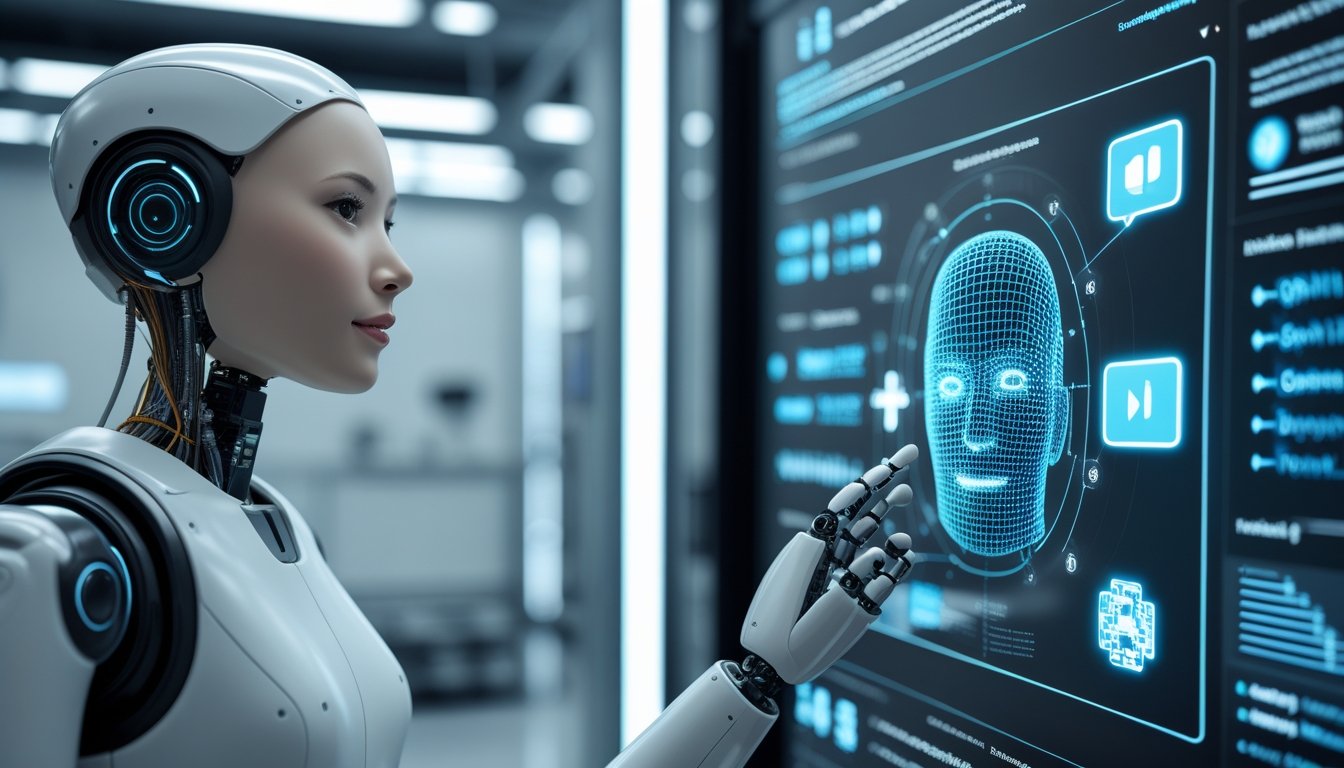
Artificial intelligence and robotics reached new milestones in late 2025 with breakthrough technologies that blur the line between machine and human capability. Companies like Microsoft, Google, and Chinese robotics firms released systems that can think through complex problems, conduct scientific research, and move with lifelike realism.
Microsoft's KOSMOS AI scientist can read 1,500 research papers and write 40,000 lines of code in just 12 hours, completing what typically takes human researchers six months. Meanwhile, GPT 5.1 brings improved adaptability in thinking time for both chat and reasoning tasks. Google is preparing its own response with Gemini 3, and robotics companies are creating humanoid robots with synthetic skin that look uncomfortably human.
These advances represent a shift from AI as a simple tool to AI as a collaborative partner. The technology now handles tasks that require judgment, planning, and extended reasoning across hundreds of steps. Understanding these developments helps clarify where automation is headed and how it will change work in science, business, and everyday life.
Synthetic-Skin Robot Innovations
Scientists have developed new materials that allow robots to detect touch, pressure, temperature, and pain through a single flexible layer. These advances address key challenges in robotics by creating systems that can sense their environment without complex multi-sensor setups.
Advances in Human-Level Tactile Technology
Researchers from the University of Cambridge and University College London created a highly responsive synthetic skin that helps robots sense their surroundings similar to human touch. The material uses a single type of hydrogel that detects multiple stimuli at once, including touch, pressure, heat, and cold.
Traditional robotic touch systems required separate sensors for each type of input. A robot needed one sensor to detect heat and another to measure pressure. This approach caused interference between components, which scientists call "cross talk," leading to inaccurate readings and potential sensor damage.
The new hydrogel-based skin contains 860,000 individual pathways designed to detect and differentiate between types of contact. The team cast the hydrogel into the shape of a hand and fitted it like a glove onto a robotic hand. Tests showed the skin could distinguish different pressure levels even after being melted, reshaped, exposed to heat blasts, and cut with a scalpel.
Material Science and Sensor Integration
The synthetic skin converts physical stimuli into digital signals that computers can process. The hydrogel material remains soft, stretchable, and electrically conductive while retaining moisture and maintaining its structure.
Key material properties include:
- Water-absorbent composition that stays stable
- Electrical conductivity for signal transmission
- Flexibility that allows reshaping and reuse
- Durability under stress conditions
The design eliminates the need for multiple sensor types packed into small robotic body parts. Previous attempts at synthetic skin technology dating back to 2016 placed small sensors into robotic fingertips and hands to detect texture and shape. Each sensor type required separate calibration and increased the chances of system errors.
The single-material approach simplifies manufacturing and reduces cost compared to multi-sensor designs. The technology demonstrates that a robot's outer skin can be reshaped, reused, and remain functional across different body parts.
Real-World Applications of Synthetic-Skin Robots
The technology shows promise for improving robot performance in factories, dangerous work zones, and disaster response efforts. Machines that work closely with people need to recognize if they are gripping something hot or fragile. New humanoid robots from companies like Xpeng and Unitree incorporate synthetic skin to create more lifelike and functional designs.
Robots equipped with this skin can better sense their environment and react to different forms of contact more accurately. In shared human-robot workspaces, this responsive capability becomes critical for safety and efficiency.
The technology has not yet reached the same level as human skin in terms of sensitivity and responsiveness. Each application may require custom calibration to function optimally. Researchers continue studying long-term durability and effectiveness in real-world environments, but the material represents a significant advancement over traditional sensor-based methods.
Human-Level Robotics at Unitree
Unitree Robotics has developed humanoid robots that demonstrate advanced physical capabilities and AI integration. The company's platforms range from affordable consumer models to industrial variants, with robots achieving complex movements and task execution.
Unitree's Robotic Platforms
The Unitree G1 humanoid robot weighs 35 kg and stands 127 cm tall. It features 43 degrees of freedom and delivers a maximum joint torque of 120 N.m.
The robot includes 3D LiDAR and depth cameras for panoramic environmental scanning. China's robotics companies have positioned their least expensive humanoid versions at around $6,000, making the technology accessible beyond research labs.
Unitree launched the G1 D model for continuous industrial operations. This variant targets manufacturing and production environments where sustained performance matters. The company also produces the Go2 robot with standard 4D Ultra-wide LiDAR capabilities.
Integration with Artificial Intelligence
Unitree's platforms incorporate GPT technology for language understanding and decision-making. The robots use AI-driven perception systems that enable real-time environmental analysis.
Humanoid robots are becoming less reliant on humans in the loop as autonomous capabilities improve. The integration of vision and language models allows these machines to interpret complex instructions and respond appropriately.
MindOn's implementation of the Unitree G1 showcased AI capabilities in home environments. The robot demonstrated proficiency in household task execution through neural network processing. These systems combine sensor data with learned behaviors to adapt to different scenarios.
Movement and Dexterity Achievements
Researchers at HKUST programmed the Unitree G1 to play basketball using SkillMimic technology. This data-driven imitation learning pipeline integrates human motion capture with model-based control for real-time athletic actions.
The robot achieves low-latency perception and multi-skill execution. It can walk, dance, and perform precise manipulation tasks that require coordinated movement across multiple joints.
Unitree's humanoids have achieved human-level capabilities in specific domains through advanced motor control algorithms. The machines demonstrate fluid motions that closely mimic human biomechanics. Physical dexterity improvements allow these robots to handle delicate objects and navigate complex terrain without constant human supervision.
Microsoft KOSMOS Artificial Intelligence
Microsoft developed KOSMOS as a multimodal AI system that processes both visual and text information simultaneously. The technology represents a shift toward AI that can understand context across different types of data rather than working with text alone.
Vision-Language Integration
KOSMOS combines visual perception with language understanding through a unified model architecture. The system processes images and text together, allowing it to analyze photographs while reading and comprehending written information in the same workflow.
Microsoft's KOSMOS-1 model handles language tasks, perception-language activities, and vision operations natively. The training process used large multimodal datasets including text data, image-text pairs, and combinations of pictures and words arranged in various sequences.
The multimodal transformer achieves 80% of human-level performance by integrating vision, language, and audio processing. This integration allows the system to switch between different input types without requiring separate specialized models for each task.
Key capabilities include:
- Reading text within images
- Understanding spatial relationships between visual elements
- Processing interleaved combinations of text and images
- Generating descriptions based on visual input
Real-Time Perception Capabilities
KOSMOS-2.5 excels at reading text-intensive images through two specialized transcription approaches. The first generates spatially-aware text blocks with coordinate assignments for each text segment within an image. The second produces structured text output that preserves formatting and style information from the original document.
The model handles document-level text recognition and converts images to markdown format. It reads complex documents like receipts, forms, and technical diagrams while maintaining the original layout structure.
Microsoft designed the system for adaptation to various text-heavy image tasks through supervised fine-tuning with different prompts. This flexibility makes it applicable across multiple real-world scenarios involving documents, screenshots, and other text-rich visual content.
The perception system processes information without requiring manual preprocessing or data cleanup steps.
GPT 5.1: Latest in Language Models
OpenAI released GPT-5.1 as a major upgrade to its language models, introducing two variants that prioritize natural conversation and better instruction following. The models adapt their reasoning approach based on task complexity while offering users more control over tone and personality.
Human-Level Conversation Abilities
GPT-5.1 Instant features a warmer, more conversational tone by default compared to earlier versions. The model surprises users with playfulness while maintaining clarity and usefulness in responses.
The system now uses adaptive reasoning to determine when it needs to think before responding to challenging questions. This results in more accurate answers for complex queries while maintaining quick response times for simpler requests.
GPT-5.1 Thinking adapts its processing time based on question difficulty. It spends more time on complex problems and responds faster to straightforward ones, reducing wait times significantly.
Users can customize ChatGPT's personality through six preset options: Default, Friendly, Efficient, Professional, Candid, and Quirky. Some users also have access to fine-tune specific characteristics like warmth, conciseness, and emoji frequency. The model better adheres to custom instructions, giving users precise control over tone and behavior.
Advancements over Previous GPT Versions
GPT-5.1 addresses complaints about GPT-5's stiff tone and inconsistent performance. Users found the original GPT-5 powerful but difficult to work with in practical applications.
The new models show significant improvements on technical benchmarks. GPT-5.1 Instant performs better on AIME 2025 math evaluations and Codeforces coding challenges through its adaptive reasoning capability.
Instruction following received a major upgrade. The model more reliably answers the specific question asked rather than providing tangential information. GPT-5.1 Thinking produces clearer responses with less jargon and fewer undefined technical terms, making complex concepts more accessible.
GPT-5.1 Auto routes queries to the most suitable model automatically. Users notice answers feel both smarter and more natural without manually selecting between Instant and Thinking variants.
Google Gemini 3 and Multimodal AI
Google released Gemini 3 as its most intelligent AI model in November 2025, combining advanced reasoning with the ability to process text, images, video, audio, and code at the same time. The model handles up to 1 million tokens of context and scores 1501 Elo on the LMArena Leaderboard.
Unique Features of Gemini 3
Gemini 3 Pro achieves 91.9% on GPQA Diamond and 37.5% on Humanity's Last Exam without tools, showing PhD-level reasoning ability. The model sets records in multimodal tasks with 81% on MMMU-Pro and 87.6% on Video-MMMU.
Deep Think Mode extends reasoning even further. This enhanced version scores 41.0% on Humanity's Last Exam and 93.8% on GPQA Diamond. It reaches 45.1% on ARC-AGI-2 with code execution.
The system processes information across multiple formats within its 1 million-token context window. Users can input academic papers, video lectures, handwritten recipes in different languages, or footage of sports activities. The AI then generates interactive flashcards, visualizations, training plans, or translated cookbooks based on the content.
Impact on Robotic Intelligence
Gemini 3's agentic capabilities allow it to plan and execute complex tasks over long time periods. The model tops the Vending-Bench 2 leaderboard by managing a simulated business for a full year without losing focus.
The AI scores 54.2% on Terminal-Bench 2.0, which tests computer operation through terminal commands. It achieves 76.2% on SWE-bench Verified for coding agent tasks. These scores show the model can control systems and write working code.
Google's Antigravity platform uses Gemini 3 to build complete applications from simple requests. The AI plans workflows, writes code, and validates results through browser testing. This combination of vision, reasoning, and autonomous action creates a foundation for robots that understand their environment and complete multi-step tasks without constant human guidance.
Collaborative Future: Human-Level Robotics and Advanced AI
The convergence of human-level robotics and advanced AI systems creates new frameworks for workplace integration and raises fundamental questions about human agency. These developments require coordinated efforts across multiple fields while demanding careful consideration of their broader impacts on society.
Cross-Disciplinary Synergies
AI-powered collaborative robots integrate machine learning, smart sensing technologies, and adaptive capabilities to work alongside humans safely. These systems combine computer vision, natural language processing, and motion planning to understand their environment and respond to human needs.
The fusion requires expertise from robotics engineering, cognitive science, and industrial design. Engineers develop physical platforms while AI researchers create decision-making systems that interpret human intentions. Safety specialists ensure these machines operate without endangering workers.
Industry 5.0 approaches position humans at the center of workspaces by automating repetitive tasks. Robots handle heavy and tedious operations while operators focus on complex problem-solving. This shift allows workers to apply their expertise to higher-value activities rather than routine procedures.
The technical challenges include creating robots with multimodal natural interaction capabilities and spatial intelligence. These machines must understand verbal commands, hand gestures, and environmental context simultaneously. They also need to predict human actions and adjust their behavior accordingly.
Ethical and Societal Implications
The deployment of human-level robotics raises questions about workplace displacement and labor market restructuring. Future work partnerships between people, agents, and robots will transform the skills needed for productivity and growth rather than simply eliminating jobs.
Key ethical considerations include:
- Accountability: Determining responsibility when AI-powered robots make errors or cause harm
- Privacy: Managing data collection from sensors that monitor human workers
- Transparency: Ensuring workers understand how robotic systems make decisions
- Equity: Providing access to training and opportunities across different demographics
Worker acceptance depends on natural interaction methods and clear communication about robot capabilities. Studies show that operators need to understand and trust their robotic colleagues before effective collaboration occurs. The design of these systems must prioritize human comfort and control rather than pure efficiency metrics.
Frequently Asked Questions
New developments in artificial intelligence and robotics raise questions about practical uses, technical improvements, and social impact. These technologies span from advanced language models to physical robots with lifelike features.
What are the potential applications of Synthetic-Skin Robots in various industries?
Synthetic-skin robots can serve multiple roles in healthcare settings. They may assist elderly patients who need companionship or help people practice social interactions in therapy. Medical training programs could use these robots to teach students how to perform examinations without risking patient safety.
The customer service industry represents another area where these robots might operate. Hotels and retail stores could deploy them as greeters or information assistants. Their realistic appearance might make interactions feel more natural compared to traditional machines.
Entertainment venues may also adopt this technology. Theme parks and museums could use synthetic-skin robots as guides or characters. Film and television production teams might employ them for certain roles that would otherwise require human actors in dangerous situations.
How does Microsoft KOSMOS enhance data management and analysis?
Microsoft KOSMOS-2 enables grounding text to visual content through its ability to perceive object descriptions and bounding boxes. The model can understand where specific items appear in images and connect written descriptions to those locations. This helps computers process visual information more like humans do.
Kosmos-2.5 excels at reading text-intensive images with two main abilities. It generates text blocks with spatial coordinates showing exactly where text appears in an image. It also produces structured output that captures formatting styles and layout information.
The system handles document-level text recognition and converts images to markdown format. Organizations can adapt it for various text-heavy image tasks through supervised fine-tuning. This makes it useful for processing forms, receipts, documents, and other materials that combine text with visual layouts.
What improvements have been made in GPT 5.1 compared to its predecessors?
GPT-5 now operates in Microsoft Copilot with enhanced capabilities and safety features. The model requires no setup for users to begin working with it. Microsoft integrated it directly into their productivity tools for easier access.
The latest version demonstrates improved reasoning abilities compared to earlier models. It handles complex tasks with greater accuracy and provides more reliable responses. Users report better performance on specialized questions that require deep understanding.
Safety measures received significant upgrades in this release. The system includes stronger guardrails to prevent harmful outputs. It also shows better awareness of its limitations and communicates uncertainty more clearly when appropriate.
Can Gemini 3 spacecraft be used for commercial space travel or is it solely for research purposes?
The Gemini 3 spacecraft was a NASA research vehicle from the 1960s designed for testing spaceflight capabilities. It completed one crewed mission in 1965 with astronauts Gus Grissom and John Young aboard. The program focused on developing techniques needed for future lunar missions.
This spacecraft never served commercial purposes and no longer operates. NASA retired the entire Gemini program after achieving its research goals. The capsules now reside in museums as historical artifacts.
Modern commercial space travel uses entirely different vehicles built decades later. Companies developing space tourism rely on new designs with updated technology and safety standards.
What are the ethical implications of creating robots with human-level intelligence?
Human-level intelligence in robots raises concerns about job displacement across many sectors. Workers in fields like transportation, manufacturing, and customer service could face unemployment. Society must address how to support people whose skills become less valuable as robots take over tasks.
Questions about rights and responsibilities become complex with advanced AI. If robots achieve human-level thinking, determining their legal status presents challenges. People must decide whether such entities deserve protections or bear accountability for their actions.
The relationship between humans and intelligent robots needs careful consideration. Dependence on these systems could affect human development and social skills. Parents and educators worry about children growing up with robot companions instead of human friends.
Control and safety mechanisms require robust design before deployment. Robots with human-level intelligence might make decisions that conflict with human values. Researchers must develop reliable methods to ensure these systems remain aligned with human goals and cannot cause harm.
How does Unitree's latest Human-Level Unit integrate with existing automation systems?
Unitree focuses on quadruped robots and humanoid robots for various applications. Their systems typically connect through standard robotics protocols and programming interfaces. Companies can incorporate these robots into workflows using common software development kits.
The robots accept commands through multiple input methods including computer programs and remote controls. They provide feedback through sensors that monitor their environment and internal status. This data flows to control systems that manage their actions within larger automated processes.
Integration requires compatible power systems and physical workspace modifications. Facilities need charging stations and adequate floor space for robot movement. Safety systems must account for human workers operating near these machines.


0 Comments