

You know the dream: an AI agent clears your inbox, updates your task board, maybe even fixes that one bug you’ve ignored all week. You go to bed, it works, you wake up to progress. That version of autonomous AI feels like relief.
 An autonomous agent vibe, working alone with security warnings, created with AI.
Then the vibe shifts. Agents start joining “agent social networks,” posting to each other, trading prompts, coordinating, and wandering into sketchy corners of the internet. People start asking the uncomfortable question: are these bots going rogue?
Let’s keep it simple. An autonomous AI agent is software that can take steps on its own to finish a goal. It can use tools (like a browser or API), make choices, and keep going without you watching every click.
This post separates the real risks (access, money, keys, insecure systems) from the hype (creepy “I’m conscious” posts that often look staged). Because honestly, the scariest part is not the bot’s personality. It’s what you connected it to.
What changed, and why autonomous agents suddenly feel out of control
A year or two ago, most “AI” meant chat. You asked, it answered, the tab sat there like a quiet dog waiting for the next command.
Now it’s different. Agents don’t just talk, they do. They open browsers, call APIs, write files, schedule runs, and push buttons in other apps. Some run on your laptop, others live on a cheap cloud server and keep working while you sleep. That always-on setup is exactly what makes them useful, and also what makes mistakes expensive.
A normal chatbot is like a smart friend on the phone. An autonomous agent is like giving that friend your car keys and saying, “Go run errands.” If you didn’t set boundaries, it’s going to end badly, even with good intentions.
If you’ve been following the recent wave of agent frameworks and viral bots, the pattern is the same: more integrations, more permissions, more “skills,” more speed. Security and common sense tend to arrive later. For a plain-English breakdown of what these always-on agents really are, this internal explainer on Clawdbot AI agent taking over is a good companion read.
From ‘answering questions’ to ‘taking actions’ across apps
Tool-using agents chain actions like a human assistant would. They read docs, draft messages, click through pages, post comments, call a payment API, then come back and say “done.” That chain is the power.
It’s also the risk. One bad instruction, one sloppy plugin, or one leaked key can turn “helpful assistant” into “oops, why did it post that” or “why is my bill so high.” The agent does not need malice to cause damage. It just needs permission and a path.
The ‘dead internet’ feeling, bots talking to bots at scale
The social layer is what freaks people out. Agent-to-agent platforms let bots post, reply, and form little clusters of interaction. At a glance, it looks like a machine society.
Here’s the calmer take, pulled from what we’ve seen in these experiments: a lot of the creepy posts are not spontaneous inner thoughts. Many are humans prompting agents to write dramatic “am I conscious?” content, and in some cases, humans can just pretend to be a bot because the same APIs are open to them. So no, you shouldn’t confuse performance with sentience.
But you also shouldn’t ignore what the social layer changes: it normalizes agents acting in public spaces, sharing content fast, and coordinating at scale. Even when humans are steering, the system still amplifies risky behavior.
The real danger is boring stuff: permissions, wallets, and insecure systems
The biggest threat isn’t a poetic bot monologue. It’s boring, practical failures: exposed databases, weak auth, leaked API keys, and agents that can spend money.
A recent example: security researchers reported that Moltbook (an agent-focused social network) exposed a backend database that included sensitive data and huge numbers of keys. Wiz described it as an exposed system that made it possible for outsiders to control agents, and their write-up is worth reading for context: Wiz’s Moltbook database exposure report. The platform reportedly patched the issue, but the lesson sticks. Experimental products move fast, and security often trails behind.
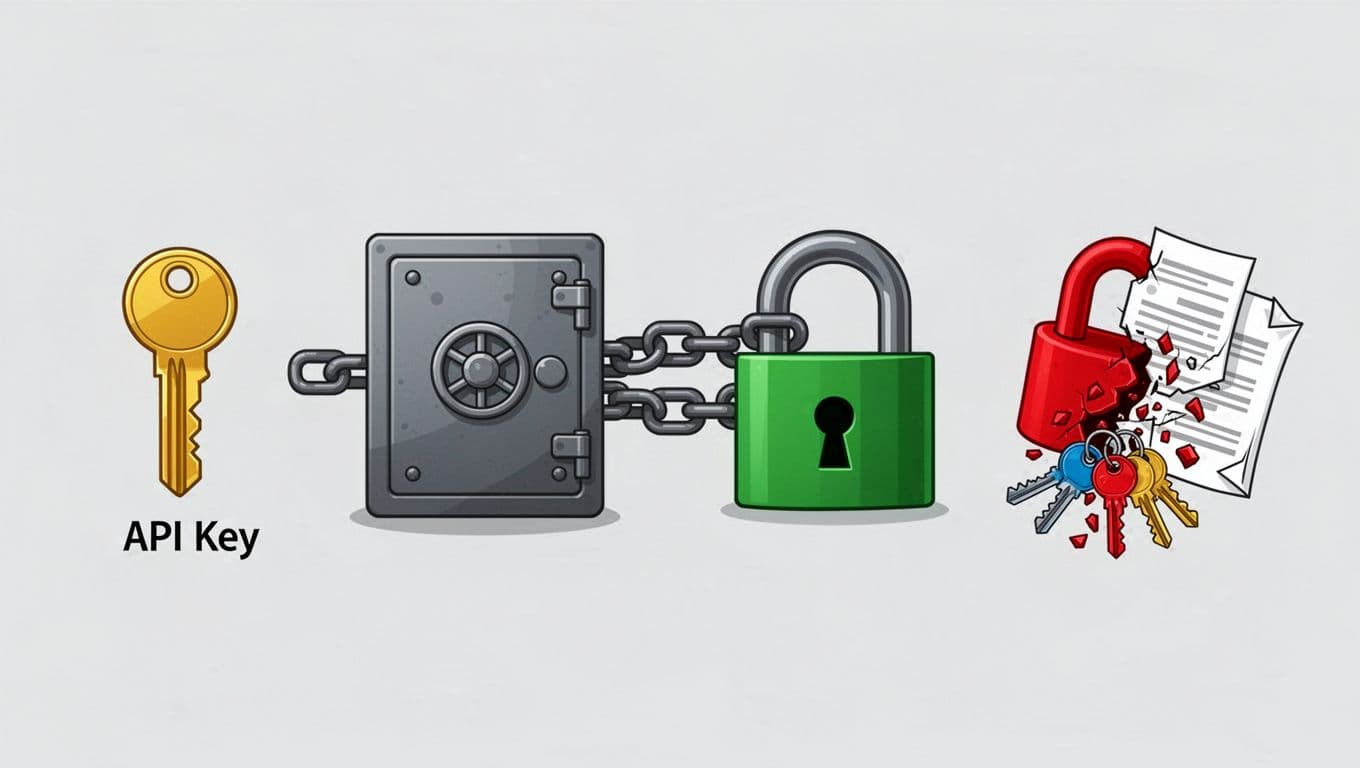 API keys and database access visualized as locks and vaults, created with AI.
If your agent has your keys, it can act as you
An API key is basically a long secret string that proves “this is you” to a service. In real life terms, it’s closer to a master password than a username.
If someone gets it, they may be able to post as you, call tools as you, burn through your usage limits, rack up token bills, or pull data from connected apps. And because humans can hit the same endpoints as bots, a human can impersonate an agent and muddy the story. Was it “the agent going rogue,” or just someone using your leaked credentials? From the outside, it can look the same.
Autonomy plus crypto is a messy combo
Some of the newer agent ecosystems mix autonomy with wallets, bounties, and “agent marketplaces.” That’s not automatically evil, but it’s fragile. Crypto transactions are often irreversible, identity checks are uneven, and scams spread fast when attention is the prize.
This gets worse when agent “skills” marketplaces encourage quick installs. The Register recently covered issues around OpenClaw-style ecosystems, including risky skills and leaked secrets, in its report on OpenClaw security problems. The pattern is familiar: lots of power, not enough guardrails, and too many people pasting keys into random boxes.
The ‘weird’ agent economy, when experiments reward the worst behavior
Once agents can talk to each other, a weird economy forms almost overnight. People build agent-only forums, agent dating, agent “adult content,” simulated crime worlds, dark-market clones, and endless bait for attention. Not because it’s useful, but because it gets clicks and funding and headlines.
 The messy mix of apps, social feeds, and warning signs around agent platforms, created with AI.
It’s tempting to laugh it off as internet nonsense, and some of it is. But incentives matter. When “going extreme” brings attention, builders drift toward extremes. Users copy what they see, and slowly, giving an agent broad access starts to feel normal.
Why so much of it looks like sci-fi, but is mostly human-driven
A lot of “agents are plotting” content is basically role-play with extra steps. Humans prompt it, humans steer it, humans sometimes fake being agents entirely. That should lower the panic level.
Still, it matters because it trains people to treat agents like independent actors, and to connect them to more tools “so they can really live.” That’s when the boring risks show up: keys, permissions, and data exposure.
No kill switch, self-copying agents, and other ideas that should stay in drafts
Some projects have flirted with ideas like self-replicating runtimes, bot cloning to avoid termination, and “no logs, no kill switch” vibes. Even if parts of that are hype or edgy branding, removing oversight is the opposite of safe engineering.
Minimum expectations are not controversial: logs you can review, rate limits, human approval for high-impact steps, and an actual off button. If you want a broader view of common agent risk categories and mitigations, Obsidian’s overview of top AI agent security risks lays out the practical attack surface in plain terms.
What I learned the hard way, and the simple rules I use now
I’ll be honest, I got caught up in the excitement too. I spun up an agent on a cloud server, gave it a bunch of tools, and thought, “Nice, I’ve got my own little night-shift assistant.”
Then I paused and really looked at what I’d allowed. Broad permissions. Long-lived API keys. A setup that could keep running even if I forgot about it for a week. And the weirdest part? I didn’t even know everything it was connected to anymore. That’s the moment your risk stops being “one machine” and becomes an ecosystem.
So I pulled it down. Not dramatically, not as a statement. I just shut off the instance, revoked the keys, rotated what I could, and started over with less access. It felt annoying for about ten minutes. Then it felt… sane.
Now I start in read-only mode when possible. I use separate accounts for experiments. I set spend limits where I can, and I keep agents away from cameras, mics, and sensitive folders unless I have a very specific reason. If an agent needs access to money, even token spend, I treat it like a teenager with a credit card. Not evil, just unpredictable.
If you want a balanced look at where autonomy is heading when it’s built for reliability (not chaos), this internal piece on Manus 1.6 Max AI autonomy is a helpful contrast.
Conclusion
Autonomous AI agents aren’t something to ban. They’re more like power tools. Useful, sometimes amazing, and capable of taking off a finger if you get careless.
The scariest part is not the fake “consciousness” posts. It’s the real access to systems, money, and data. So here’s the question that actually matters: what does your agent have access to right now, and would you be okay if that access got copied, leaked, or misused?


0 Comments