

Picture this. You work at Google, one of the most efficient business machines ever built. You ship projects, hit targets, and you think 2025 went pretty well.
Then an email lands in your inbox with a tone that feels, honestly, different. Not warm. Not fluffy. More like: "2025 was great, but the pace is about to get electric." The stakes are higher now, and everyone needs to be all in on AI. If that speed is not for you, there is a door, and it comes with a severance check.
That email is not a thought experiment. It reflects a real shift inside Google, where some US employees in its Global Business Organization have been offered a voluntary exit package. It is not being labeled a mass layoff (at least not officially), but it still sends a clear message: the company wants to move faster on google ai, and it wants teams that can match that pace.
The email that changes the mood inside Google
 An office moment where a single email shifts the tone at work, created with AI.
For years, Google (and big tech in general) carried a certain vibe. Not just "smart people building useful things," but also comfort. Stability. A lot of internal mobility. The kind of workplace where the perks became part of the legend.
So when a message arrives that basically says, "Get aligned with AI or consider leaving," it hits harder than a normal corporate memo. It is not just about restructuring, it is about identity. The note, sent by Google's chief business officer, makes the direction explicit: AI is the future, and if you are not aligned with that future, you can opt out.
That framing matters. "Opt out" sounds polite, even respectful. But the subtext is still pressure. The pace is speeding up, and the company is signaling that it wants people who are excited by that speed. Anyone who is not, well, they can leave with compensation.
If you want the original publisher's ongoing coverage, their updates often appear on their YouTube news page, but the core point stands without any extra context: Google is putting AI commitment in writing, and pairing it with a check.
What a "voluntary exit program" really means, and who gets it
A voluntary exit program sounds simple: the company offers money, employees choose to leave, and everyone avoids the uglier version of the same outcome.
In this case, the offer is aimed at employees in Google's Global Business Organization in the US. The memo reportedly points toward specific parts of the org, including roles tied to solutions work, sales-related functions, and corporate development. However, one detail stands out because it is so telling.
Customer-facing sales teams are not eligible.
That one line basically admits what Google is trying to protect while it reorganizes: the revenue engine. The company does not want disruption where it sells, renews, and keeps relationships steady. So the offer targets certain internal roles, while shielding the teams that directly touch customers and money.
It is a very "big company" move, but it is also a practical one. If you change too much, too fast, you risk short-term revenue. And even in an AI sprint, short-term revenue still funds the sprint.
For a quick outside report on the buyouts, here is one example from the business press: reporting on Google's exit packages. Details vary by team and timing, but the theme stays consistent: an AI-focused reset, done in a way that tries to keep the cash register ringing.
How much money could be on the table (and why the numbers matter)
Google has not publicly shared the exact terms of this round of exit packages. That part is important. A lot of people see a headline and assume a standard payout, but companies can tweak packages based on level, location, org, and legal considerations.
Still, there is a reference point. A similar buyout package reported last year included at least 14 weeks of pay, plus one additional week for every full year of service. So someone with a decade at the company could be looking at roughly 24 weeks of pay.
To make the math easier to see, here is what that structure looks like as a simple example (again, this is based on the previously reported package, not a confirmed term sheet for the current offer).
| Years of service | Base pay (weeks) | Extra (weeks) | Estimated total (weeks) |
|---|---|---|---|
| 0 | 14 | 0 | 14 |
| 1 | 14 | 1 | 15 |
| 5 | 14 | 5 | 19 |
| 10 | 14 | 10 | 24 |
The takeaway is not "this is good" or "this is bad." It is that the payout can be meaningful enough to tempt people who already felt tired, stuck, or quietly mismatched with where things are going. And that is the point of a buyout. You are not just reducing headcount, you are inviting self-selection.
Why buyouts happen before layoffs (the quiet logic behind it)
Buyouts are cleaner than layoffs. That is the part companies rarely say out loud, but everyone in corporate life kind of knows.
A layoff creates noise. It increases legal risk. It can bring regulatory complications. It can also become a reputational story that lasts longer than leadership wants. On the other hand, a voluntary exit program lets the company say, "We offered choice." Even if the choice feels... narrow.
Here is why companies like buyouts, in plain terms:
- Lower legal risk because people choose to sign and leave
- Less public blowback compared with forced cuts
- More control over timing since exits can be staged
- A quieter way to trim without looking like the business is in trouble
And there is a second layer that matters: buyouts often come first. If not enough people take the package, harsher cuts can follow. The metaphor that sticks is: a polite knock before the bulldozer.
This is also why the memo tone matters. When leadership mixes urgency ("electric pace") with a financial offramp, it can motivate exits without triggering the same panic that a "layoff list" triggers.
The AI layoff story is everywhere, but the data is messy
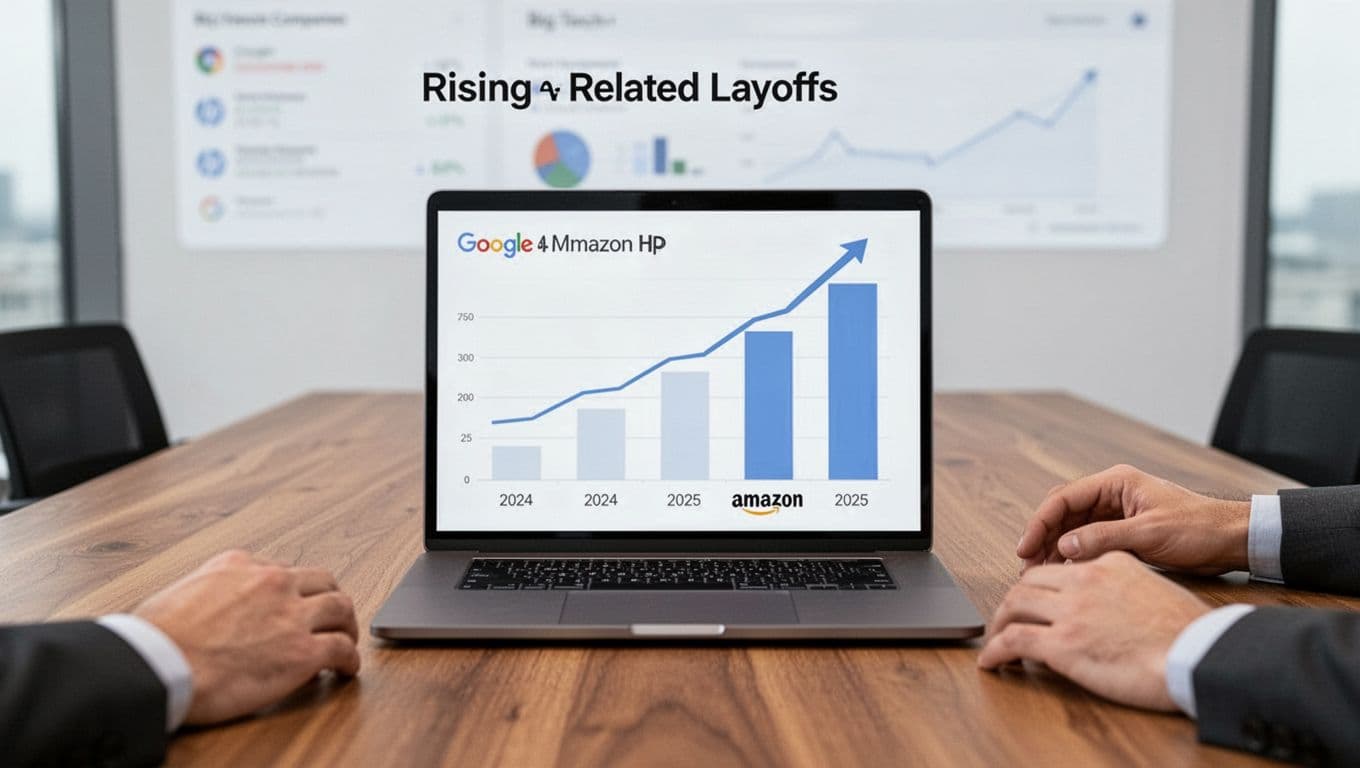 A visual hint at how AI-related layoff stories are often presented, created with AI.
In 2025, reports claimed more than 54,000 US layoffs were attributed to AI. That number gets repeated because it is sharp and scary. It makes the story feel simple: AI arrives, humans leave.
Then you see the supporting examples used again and again. Amazon cut tens of thousands of jobs. HP signaled thousands more reductions. Duolingo said it would stop using contractors for work AI can handle. Salesforce's CEO has openly talked about AI agents reducing the need for staff.
It is not that AI has no effect. It clearly does. Automation is real, and some tasks are getting eaten quickly, especially repetitive work in content, support, and basic analysis. But the story is also becoming a convenient wrapper for other business moves.
One reason people are skeptical is that "AI-driven layoffs" is a fuzzy label. Did the company replace a team with an AI system today, or did it cut costs because it overhired, then sprinkle AI into the press release? Those are two very different things.
For a look at how some of these AI layoff claims can be misleading, see this coverage: analysis of claimed AI-driven layoff spikes.
Economists say only 6% of jobs may be automated by 2030
This is where the narrative gets awkward.
A major research view mentioned in the reporting says only 6% of American jobs will be automated by 2030. Not 60%. Not 30%. Just 6%. That does not mean "no disruption." It does mean the popular story of instant mass replacement does not line up neatly with at least some economic forecasts.
So how can both things be true?
Because "automation" is not the same as "job loss." A job can absorb AI tools and still exist. A team can shrink without vanishing. Also, some companies cut staff for reasons that have nothing to do with AI, then talk about AI anyway because it sounds better.
For a mainstream summary of this skepticism, see: Yale Budget Lab concerns about AI-washing.
If that 6% figure is even close, then a lot of what people feel right now is not pure automation. It is restructuring, cost pressure, and a new internal expectation that everyone should work faster because AI tools exist.
"AI washing" is the new corporate language hack
 A symbolic handoff between humans and automation inside a corporate office, created with AI.
"AI washing" is the term floating around for this pattern: companies attributing layoffs to AI efficiency, even when the real drivers are older and less exciting.
Sometimes a business overhired during a boom. Sometimes margins got squeezed. Sometimes leadership made a bet that did not pay off fast enough. Those reasons sound ordinary, even a bit embarrassing. AI sounds futuristic. AI sounds like progress.
And investors tend to reward progress stories.
Here is how the difference can sound in real life:
"We overhired and need to protect margins."
Versus:
"We are getting leaner because of AI innovation."
Same outcome. Different story. One creates doubt, the other creates a narrative of momentum.
This is also where Google's move can be read two ways. It might be a structural reset where AI truly changes what roles are needed. Or it might be partially AI washing, a way to trim and reshape while keeping the headline focused on the future.
If you are interested in how hype cycles and business pressure combine, this internal piece connects well with the moment we're in: AI bubble signals in January 2026.
The Google culture shift, from dream job to survival mode
 A visual contrast between perk-heavy comfort and the urgency of AI build mode, created with AI.
For years, Google sold a workplace dream. Free food. Flexible hours. Smart coworkers. Build cool stuff. Even people who never worked there absorbed the myth, because it was everywhere.
But the message now feels simpler and sharper: move fast, think AI, or move on.
That does not mean perks vanish overnight, or that Google suddenly becomes a bad place to work. It means the cultural center of gravity shifts. The AI race is a sprint right now, and Google cannot afford to look slow, especially with search habits changing and competitors pushing new AI products into daily life.
So the buyout becomes more than a headcount move. It signals a new type of internal loyalty test. Not loyalty to a manager, or a product line, but loyalty to speed and AI-first thinking.
And, well, that is not the same thing as the old deal.
What I learned personally watching this moment unfold
I have seen enough workplace "direction changes" to know the pattern. It never starts with a layoff calendar on day one. It starts with language. The tone gets tighter. Emails get more direct. Suddenly everyone is using the same words, "all in," "pace," "mission," "urgency." You can feel it in meetings even before the org chart changes.
What hit me here is how openly AI is being used as the measuring stick for belonging. Not "Are you good at your job?" but "Are you excited about the speed we want now?" That is a different kind of question, and it can mess with your head if you are steady and methodical by nature.
Also, I keep thinking about the teams that are protected, like customer-facing sales. It is a reminder that even in an AI obsessed season, revenue still rules. The future talk is loud, but the money talk stays quiet and consistent.
Mostly, I walked away feeling this: google ai is not just a product push anymore. It is becoming a culture filter.
Conclusion: the real ultimatum is about speed, not just AI
Google's voluntary exit packages might look polite on paper, but the underlying message is blunt: the company wants an AI-first workforce that can handle a faster tempo. Buyouts keep things quieter than layoffs, yet they often show up right before deeper cuts or bigger reshuffles. At the same time, the wider "AI layoffs" story is getting muddy, because automation is real, but so is AI washing. The uncomfortable truth is that big tech comfort is fading, and big tech survival mode is taking its place.


0 Comments