

If you want to make real money with ai tools in 2026, you need two things: a boring plan that works, and the patience to execute it when it stops feeling exciting.
Here’s the realistic promise. Most people won’t hit $1M in profit in 12 months, even with the best tools. But plenty of focused builders can get to $10K to $20K per month, which is a life upgrade on its own, and a strong base to push for a million-dollar year later.
The personal angle, kept practical: a young founder I follow closely shared he’s on track for just under $10M online revenue in 2025, with take-home profits over $1M, and he credits obsessive tool usage and tight execution, not luck. He started with no AI background, built a service business, and treated AI like a workbench, not a lottery ticket. That mindset is what this guide is built on.
Below is a simple playbook (learn, sell, teach) and the 10 tools that map to it.
The only plan that makes sense: learn it, sell it, then teach it (without the hype)
Making a million isn’t a “pick the right tool” problem. It’s a repeatable offer problem.
A proven path looks like this:
- Learn one skill that creates business outcomes (time saved, leads captured, faster content, fewer missed calls, better follow-up).
- Sell it as a service to small businesses first, because they move faster and feel pain sooner.
- Teach and package what works into templates, workshops, and a small product, so your time stops being the ceiling.
Why this works well in 2026: AI adoption is moving from “fun experiments” to “show me ROI.” If you want context on where AI is heading next, this overview of 2026 technology trends shaping AI for business is a solid read, especially on agent workflows and low-code.
A few guardrails that keep you out of the weeds:
- Pick one lane and stay there for 90 days.
- Start with small businesses, then move up-market once your delivery is clean.
- Track profit and hours, not followers, not “busy.”
- Use tools to ship faster, not to make your work look fancy.
Pick one money lane: AI education, AI consulting, or AI automation builds
AI education: You train teams to use LLMs safely and consistently.
Example offers: a 2-hour “AI basics for teams” workshop ($500 to $2,500), a department playbook ($1,000 to $5,000), prompt libraries with SOPs ($300 to $1,500).
AI consulting: You audit workflows and recommend quick wins.
Example offers: an AI tools audit ($750 to $3,000), a 30-day rollout plan ($1,500 to $7,500), a compliance and policy starter kit ($500 to $2,500).
AI automation builds: You connect tools to remove busywork.
Example offers: lead follow-up automation ($1,000 to $5,000), intake forms to CRM pipeline ($750 to $3,500), weekly reporting automation ($500 to $2,500).
The key idea from the field: you don’t need to be a genius. You need to be one or two steps ahead of the client, and willing to learn fast and do real work.
A simple roadmap graphic from idea to first $10K per month
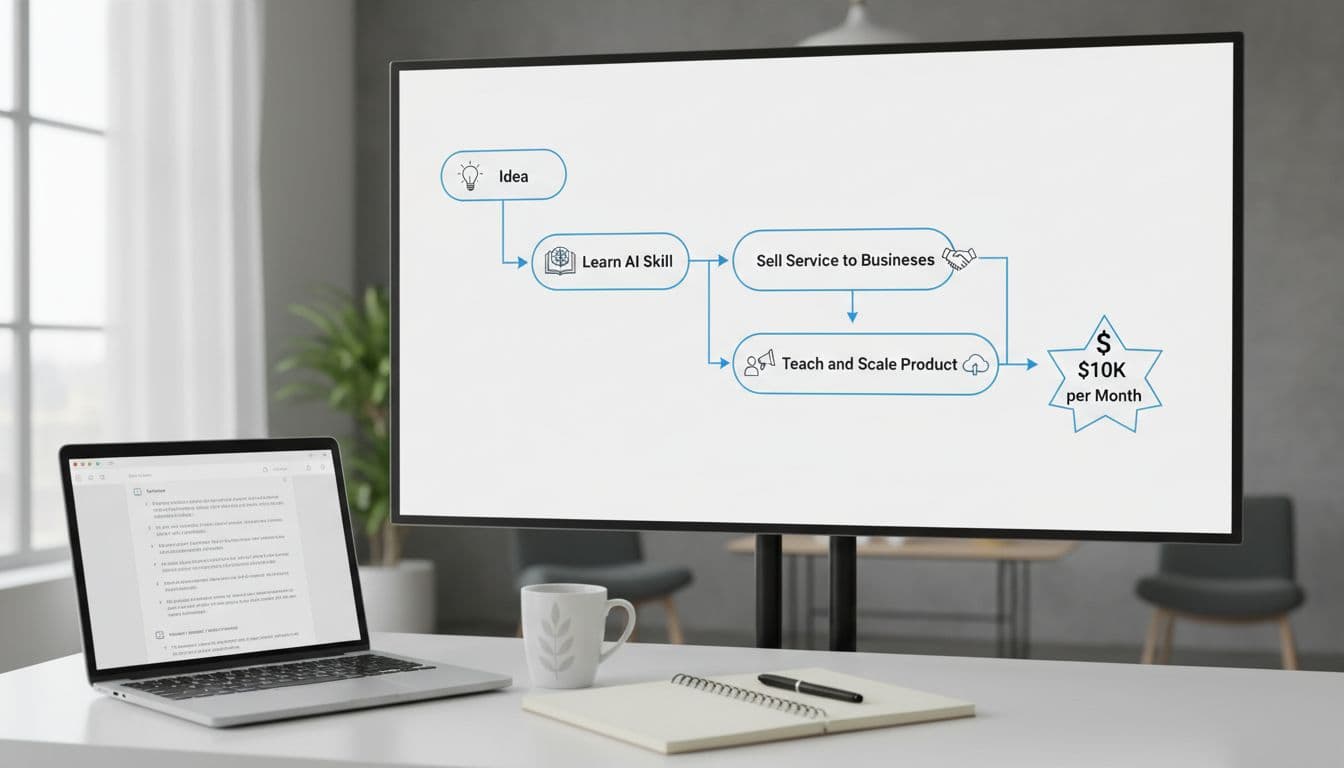 Roadmap from learning one AI skill, to selling a service, to packaging what works into a scalable product (created with AI).
The 10 AI tools that can help you reach your first million in 2026
The tools below won’t make you rich by themselves. They help you deliver outcomes faster, sell with better assets, and create enough volume to get traction.
For each tool: what it does, how it makes money, a first step, and a mistake to avoid.
Core thinking and writing tools: ChatGPT and Claude (plus Jasper for brand output)
1) ChatGPT
What it does: Fast drafting, analysis, SOP writing, prompt-based workflows, and lightweight “copilot” tasks across roles. In December 2025, ChatGPT also added more tone controls, stronger instruction-following, and expanded “Memory” behaviors for more personalized work over time.
Best way to make money with it: Sell an “AI starter pack” for a local business: email templates, call scripts, FAQ answers, and a simple SOP for the team to follow.
First step: Build a 1-page “prompt menu” for one department (sales or support).
Common mistake: Treating it like an oracle. Always verify claims, numbers, and policies.
2) Claude
What it does: Strong writing quality, long-document handling, and clear reasoning for policies, proposals, and internal docs.
Best way to make money with it: Offer “internal knowledge cleanup” for small teams: rewrite messy docs, create a usable handbook, and add reusable templates.
First step: Take one client’s messy doc and turn it into a clean SOP plus a checklist.
Common mistake: Dumping sensitive client data into tools without permission and safeguards.
3) Jasper
What it does: Brand-consistent marketing content, ad variations, and scalable copy output when you need consistent voice.
Best way to make money with it: Monthly content retainer for a niche (dentists, roofers, gyms): 4 posts, 2 emails, 10 ad variants, plus landing page refresh.
First step: Create one “brand voice” profile from a client’s past best-performing copy.
Common mistake: Publishing generic AI copy. You still need examples, proof, and specifics.
If you want more monetization ideas to stack around content and services, Shopify’s list of ways to make money using AI is a useful menu of directions.
Build and ship fast without coding: Notion AI and Gumloop
4) Notion AI
What it does: Turns messy notes into structured docs, summaries, project plans, client portals, and knowledge bases.
Best way to make money with it: Sell a “client onboarding hub” that includes intake forms, meeting notes, project timelines, and a FAQ page.
First step: Create a reusable workspace template for your niche.
Common mistake: Overbuilding the workspace. A simple hub that gets used beats a beautiful one nobody opens.
Also Read: Moltbook Just Stunned the AI Industry, and the “Out of Control” Talk Is Getting Loud
5) Gumloop
What it does: No-code AI workflows that chain tasks together (content pipelines, data cleanup, routing, and internal ops).
Best way to make money with it: Build a weekly “marketing ops machine” for a business: capture ideas, draft assets, route approvals, schedule publishing.
First step: Automate one boring step you personally do every week (summaries, repurposing, categorizing leads).
Common mistake: Automating chaos. Fix the process first, then automate.
Quick checklist for a first client automation that actually saves time:
- Capture leads from form or inbox
- Categorize by service type
- Send immediate confirmation reply
- Create CRM task for follow-up
- Add the lead to a simple nurture email
For broader, grounded side-hustle style options in 2026, RightBlogger’s guide on how to make money with AI in 2026 is surprisingly practical.
Automate ops and follow-ups: Zapier AI and HubSpot AI
6) Zapier AI
What it does: Connects apps and triggers actions across your client’s stack (forms, email, CRM, calendar, spreadsheets).
Best way to make money with it: “Missed lead rescue” automation for service businesses: instant replies, routing, and follow-up tasks so leads don’t rot.
First step: Map the lead journey on paper, then automate the first two steps only.
Common mistake: Building a 30-step Zap that breaks weekly. Keep it simple and observable.
7) HubSpot AI
What it does: CRM support, email drafting, pipeline help, and faster sales workflows inside HubSpot.
Best way to make money with it: Package a “sales pipeline setup” service: CRM stages, sequences, templates, and reporting.
First step: Define pipeline stages and required fields, then set basic automation for task reminders.
Common mistake: Using AI emails without personalization. A bland email is still a bland email.
 Photo by Mikael Blomkvist
Sell and close with better assets: Gamma and Attio
8) Gamma
What it does: Turns notes into clean proposal decks quickly. Speed matters because leads go cold.
Best way to make money with it: Close more of the work you already earn the right to pitch, by sending a polished proposal within 24 hours.
First step: Create a proposal template with 6 slides (problem, outcome, scope, timeline, price, next steps).
Common mistake: Over-designing. Clarity beats fancy transitions.
9) Attio
What it does: A lightweight CRM for tracking outreach, relationships, and deal stages without the mess.
Best way to make money with it: Run consistent outbound and stop losing leads to spreadsheets and DMs.
First step: Set up stages: Prospect, Contacted, Booked, Proposed, Closed, Lost.
Common mistake: Tracking everything except the next action. Every deal needs a next step.
A simple weekly scoreboard that keeps you honest:
- Meetings booked
- Proposals sent
- Close rate
- Delivery hours per client
- Profit per project
Create attention and products: Synthesia (and use your writing tools for scripts)
10) Synthesia
What it does: Produces professional videos quickly for explainers, ads, onboarding, and course lessons, without filming yourself every time.
Best way to make money with it: Offer “video ad and explainer bundles” to local service businesses, or create your own mini-course that sells your audit or workshop.
First step: Make a 60-second explainer for one niche problem (missed calls, slow quote turnaround, poor follow-up).
Common mistake: Posting faceless video spam. Use real examples, show the workflow, and keep claims grounded.
For more perspectives on earning with AI in 2026, Neal Schaffer’s overview of how to make money with AI in 2026 is a good reality-check style companion.
What I learned using AI tools to scale income: the real rules for 2026
The most useful lesson from people doing real numbers with AI: tools don’t replace the hard parts. They just compress time.
From the founder story in my notes: he didn’t start as an AI expert. He started with a service business, learned one area deeply enough to sell it, then kept shipping real client outcomes. He also emphasized that aiming for $1M in a year is hard, and most won’t hit it, but many can land in that $10K to $20K monthly range. That level alone can change what you can do with your life, and it sets the foundation for bigger goals later.
Two tactical takeaways that matter more than any tool list:
- Sell outcomes, not AI. Nobody buys “automation.” They buy “no missed leads” and “faster quotes.”
- Stay honest. The fastest way to crash is pretending you have results you don’t.
Use fewer tools than you think: get great at one skill and one offer
Most beginners lose because they collect apps like trading cards.
Pick:
- One niche (start local if needed).
- One offer you can deliver in 7 days.
- One main build tool (Gumloop or Zapier).
- One writing brain (ChatGPT or Claude).
- One system of record (Notion + a simple CRM).
Do that for 90 days. You’ll build a feedback loop where client work improves your template, and your template makes delivery faster.
Your 30-day starter plan to land clients and build momentum in 2026
You don’t need a perfect brand. You need proof, a clear offer, and reps.
Week 1: Learn and build samples (6 to 8 hours total)
- Pick a niche and one pain (missed leads, slow follow-up, messy onboarding).
- Build one demo: a Notion client hub or a Zapier lead rescue flow.
- Write a one-page offer with scope, timeline, and price.
Week 2: Outreach and offers
- Send 10 targeted messages per day (50 total).
- Book 3 to 5 calls.
- Pitch one simple outcome, one price, one timeline.
Week 3: Deliver and document results
- Ship in 7 days.
- Track baseline vs after (response time, leads touched, hours saved).
- Ask for a testimonial tied to a measurable change.
Week 4: Package into a repeatable system
- Turn delivery into a checklist.
- Create templates (proposal deck, onboarding doc, automation map).
- Raise your price slightly, or add a monthly support retainer.
Short checklist for choosing a niche fast:
- They answer phones or rely on leads.
- They have high customer value (so ROI is obvious).
- They’re busy, not broke.
- You can reach them easily (local, groups, directories).
Warning: don’t overbuild. Your first goal is a paid project, not a “platform.”
Conclusion
The tools don’t make you rich. The offers do.
Pick one lane, choose a small stack from these 10 ai tools, and ship something a real business will pay for. Even hitting $10K to $20K per month can change where you live, how you work, and what you can say “yes” to in 2026. Start this week: learn one tool, build one demo, and pitch one simple outcome.


0 Comments